October 12: Spain's National Day Written in Light and Shadow
Some national holidays feel casual, almost effortless — picnics, beach days, music drifting from open windows. October 12 in Spain is not one of those days. It arrives with formality, uniforms, symbols, and a kind of choreography that feels inherited rather than invented. The morning belongs to precision, ceremony, and centuries of story; the night belongs to celebration and fire.
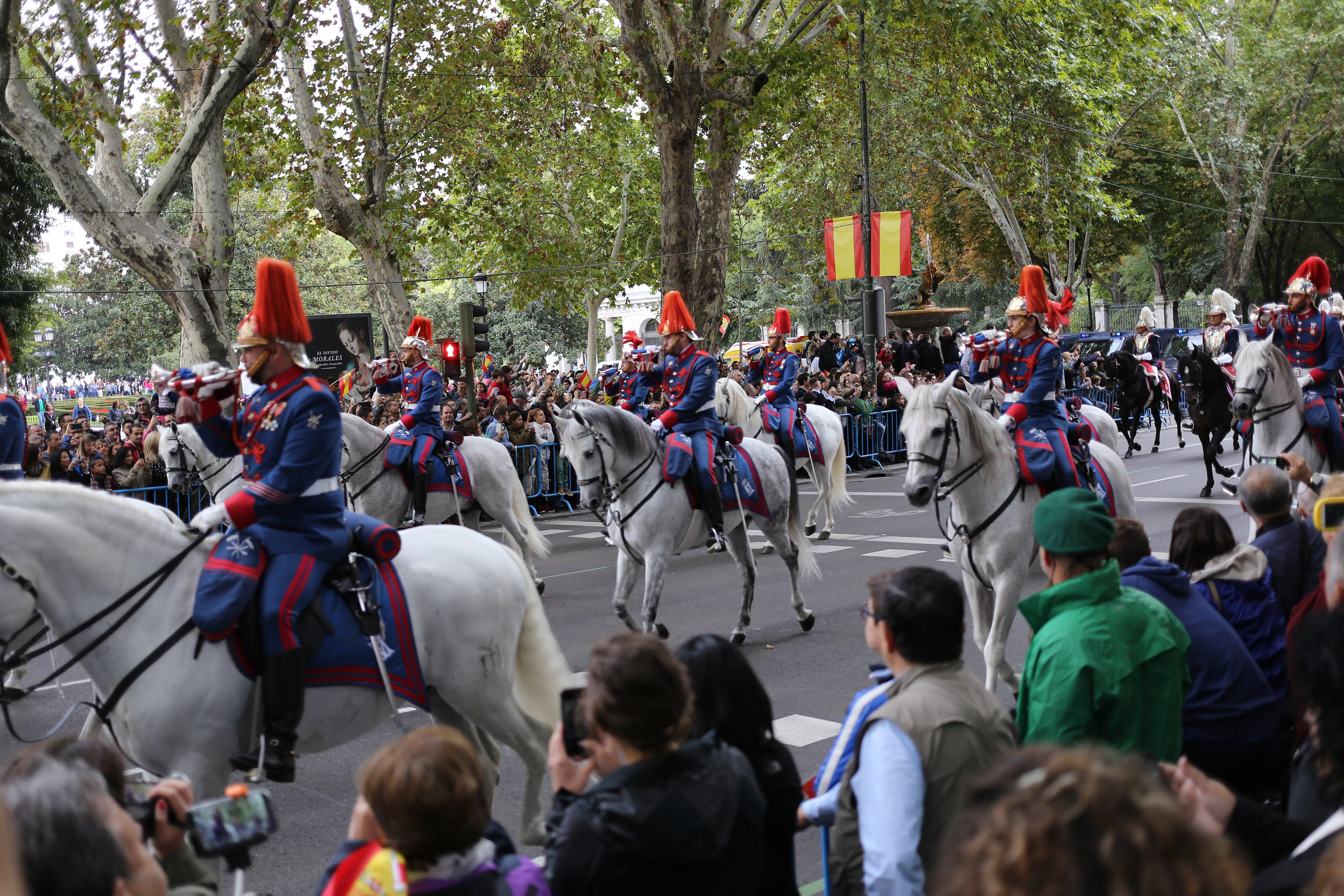
The photograph from the parade captures the first heartbeat of the day: ranks of horses moving down a wide Madrid boulevard, their steps measured and unhurried. The riders — in deep blue uniforms trimmed with red, tall orange plumes rising from polished helmets — sit tall, almost regal. Children climb railings for a better view, phones rise like a forest of small screens, and flags ripple from barricades and balconies. Nothing rushes. The atmosphere feels serious but celebratory, as if everyone understands they are witnessing not just a parade but a ritual.
This scene traces its meaning back to October 12, 1492, the date recorded as the moment Christopher Columbus reached the Americas under the Spanish flag. For centuries the story was framed as exploration, discovery, and the beginning of Spain’s global identity. Over time, the understanding deepened — and fractured. Across Latin America, the same day is remembered through very different vocabulary: resistance, loss, colonization, survival. In Spain, those interpretations hover in the background — sometimes quietly, sometimes loudly — but the holiday itself remains a focal point for national identity.
After the last horse passes and the brass bands fade, the day softens. People drift toward food, conversation, parks, plazas. The holiday stretches into afternoon without urgency.
Then comes the second heartbeat — the sky.
In the fireworks image, the night explodes into streaks of gold and bursts of crimson. Smoke glows pink as sparks rain downward in slow glittering arcs. The silhouettes of buildings sit dark at the bottom of the frame, small and earthly, while the sky behaves like a stage curtain set on fire. There’s nothing formal about this moment — no marching order, no sequence to memorize — just spectacle. The kind that makes strangers pause mid-sentence and children forget what they were talking about.
If the parade is tradition — rooted in uniforms, hierarchy, and royal presence — then the fireworks are the emotional echo: joy, spectacle, noise, and shared awe.
Some holidays divide people. Some unite them. October 12 does both, depending on where you stand — geographically, culturally, historically. But it also does something subtle and perhaps more important: it reminds everyone that memory is not static.
A single date can be triumph or wound, heritage or question — and sometimes all of these at once.
And so October 12 continues, year after year: morning marked by ceremony, evening lit by fire, and the space in between filled with reflection, identity, and the ongoing conversation between history and the present.
A day that doesn’t just look back — but asks how the story should be carried forward.