Frank Gehry, December 5, 2025 — Bilbao
The news hit with that strange, delayed weight that comes when a giant leaves the world — you already felt their presence was larger than a single lifetime, and yet suddenly it’s finite, marked by a date. Looking at the Guggenheim Bilbao today, from this angle where the titanium curves gather the grey sky and the mirrored spheres seem to swallow up fragments of people passing by, you can almost feel Gehry’s mind still working through the metal. His buildings never behaved like buildings; they rippled, folded, drifted, as if they’d been caught mid-gesture. That was always part of the magic — the sense that something static was trying to become something alive, almost breathing.
This museum in particular feels like his spirit anchored in steel. The great, uneven plates catch the light in such a temperamental way that even on a cloudy day the whole place hums faintly, like a chord you can’t quite place. You watch people walk underneath the massive forms, dwarfed yet strangely comfortable, and you’re reminded how Gehry insisted that architecture shouldn’t intimidate — it should surprise, embrace, even misbehave a little. He never tried to tidy the world; he wanted it to twist and shimmer and laugh at its own seriousness.
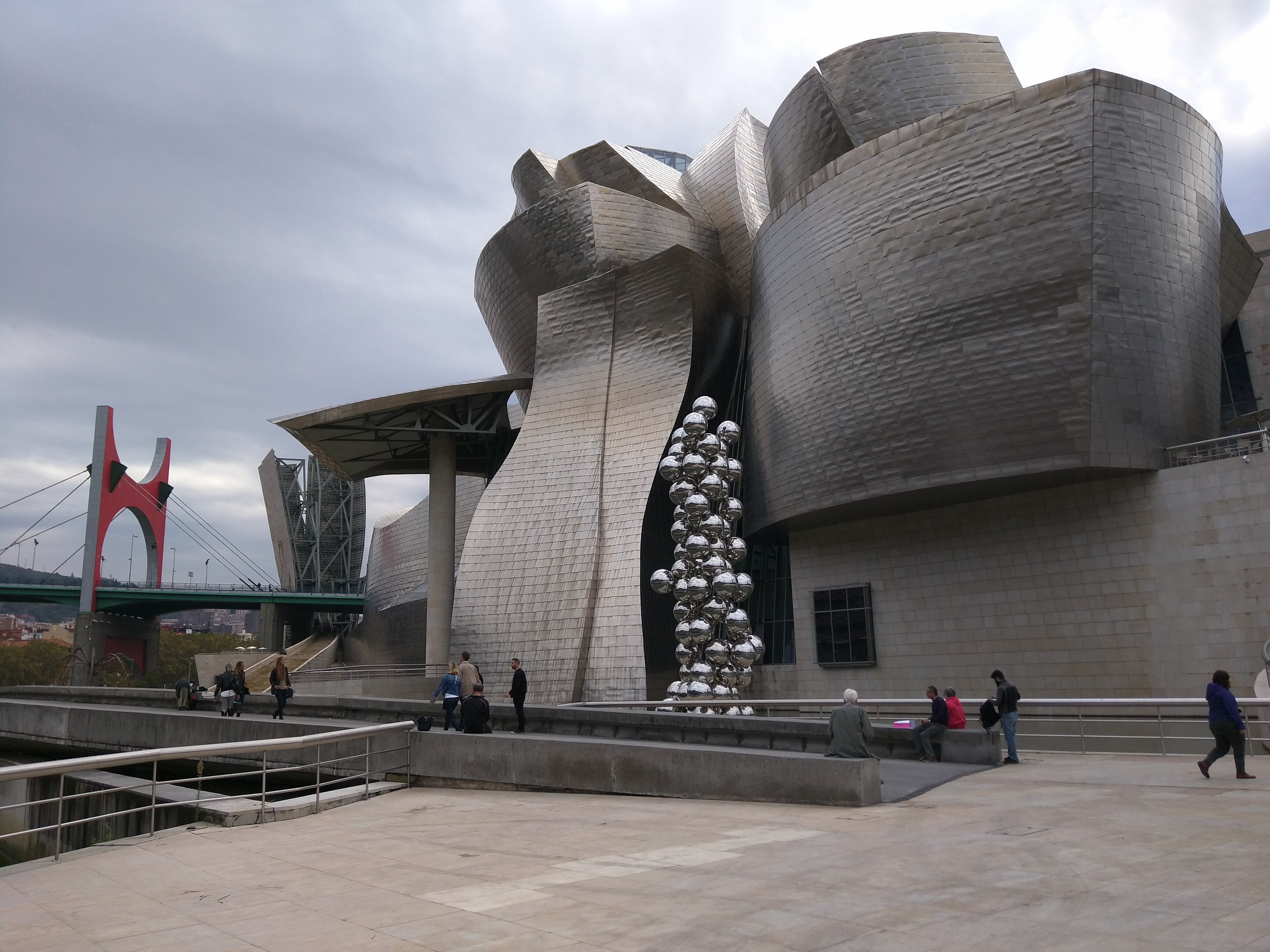
What lingers now is the audacity of his imagination. Few artists had the nerve to bend entire cities toward a new vocabulary, and fewer still managed to make those cities grateful for it. Bilbao didn’t just get a museum — it got a rebirth, an identity, a skyline with a pulse. And in that sculpture of mirrored spheres, reflecting every passerby as a tiny, shifting universe, there’s a quiet reminder of how Gehry worked: playful, precise, and deeply human.
Losing him feels like losing a particular kind of daring. But standing here — or even just looking at this photo — you get the sense that he left behind enough movement in the metal to keep going without him. The building still leans into the wind, still gathers strangers beneath its wings, still tells the world that beauty can be unruly and still make perfect sense.