Between Eras, 2:14 PM, Manhattan
A gray afternoon hangs over Manhattan like a held breath, the kind that flattens sound and makes time feel oddly negotiable. The sky is a pale, indifferent sheet, not dramatic enough to be stormy, not generous enough to let light through. In the foreground, the street is wet and slightly reflective, carrying a faint sheen that turns traffic lights and passing buses into soft smudges of color. Pedestrians move with that particular New York efficiency—coats zipped, shoulders slightly hunched, faces forward—walking not just through space but through schedules, obligations, mental lists. Two figures pass close to the camera on the right, bundled against the cold, their expressions unreadable, almost inward, as if the city around them were background noise rather than spectacle.
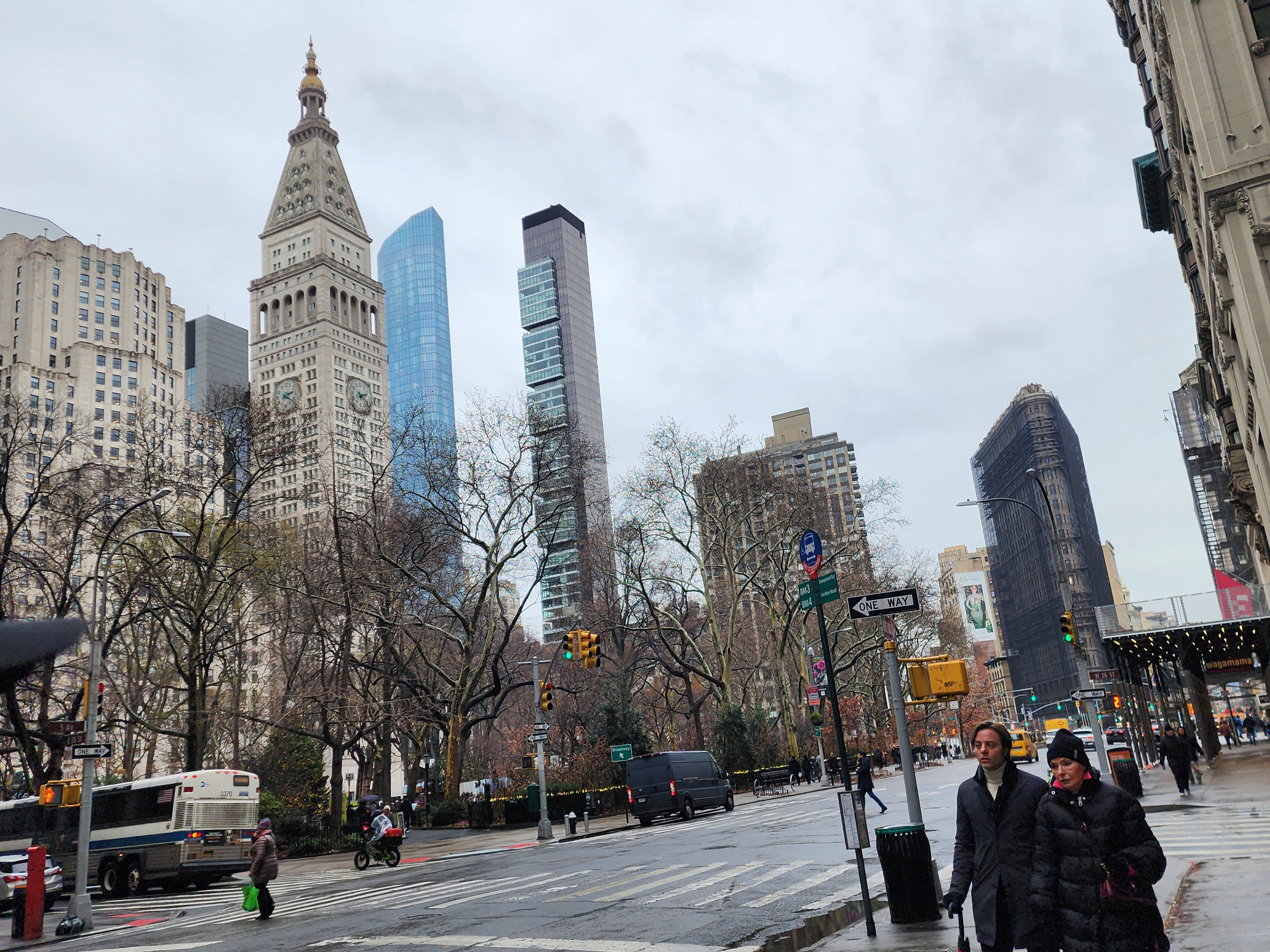
What makes the scene quietly powerful is the collision of architectural time layered into a single glance. To the left, the ornate, pale stone tower with its clock faces and decorative crown stands like a patient witness from another century, rooted, vertical, unbothered by trends. Behind it rise newer forms—sleek glass and dark, angular slabs—buildings that feel lighter, faster, more provisional, as if they could be replaced without ceremony. Bare winter trees thread through everything, their branches drawing thin, nervous lines across facades old and new, a reminder that seasons ignore urban ambition. Even the Flatiron Building appears in the distance, partially veiled, its familiar triangular silhouette subdued, almost shy, wrapped in scaffolding and shadow as if temporarily unsure of its role.
The intersection itself becomes a kind of time valve. Traffic pauses, pedestrians wait, signals change, and for a brief moment everything aligns—old masonry, modern glass, leafless trees, buses, delivery vans, people with places to be. Nothing announces itself as important, and that’s the point. This is not a landmark moment or a postcard angle; it’s a slice of accumulated minutes, the kind that make up most of life and most cities. Time here doesn’t rush, but it doesn’t stop either. It just continues, indifferent yet intimate, letting architecture age, letting people pass through, letting the light fade a little more each winter afternoon. Perfect, really, for Timey.org—where moments aren’t frozen, just quietly observed before they move on.