Hannover Messe: Trade Fair for the Manufacturing Industry, 20–24 April 2026, Hannover, Germany
The photograph captures a moment inside one of those vast, carefully engineered exhibition halls where scale quietly does the talking before any brochure or keynote ever can. Overhead, a lattice of trusses and spotlights stretches across the ceiling like industrial scaffolding turned architectural statement, bathing the space in a clean, neutral light that feels purposeful rather than dramatic. Below it, a sequence of white, geometric booth structures forms a kind of modern colonnade, each one crisp-edged and modular, designed to signal efficiency, order, and control. The deep blue carpet anchors everything, softening the acoustics and adding that familiar trade-fair calm where thousands of conversations somehow coexist without tipping into chaos. Seen now, this CeBIT scene reads as a clear predecessor to events like Hannover Messe in its current form. The DNA is all here: the emphasis on systems over gadgets, on infrastructure over flash, on long-term industrial relevance rather than short-lived hype. CeBIT laid the groundwork for how Europe, in particular, framed the conversation around digital transformation and manufacturing intelligence. This photo doesn’t just document a trade fair; it captures a transitional moment, when enterprise IT and industrial technology were converging into something larger, more integrated. A bit orderly, a bit idealistic, and unmistakably foundational.
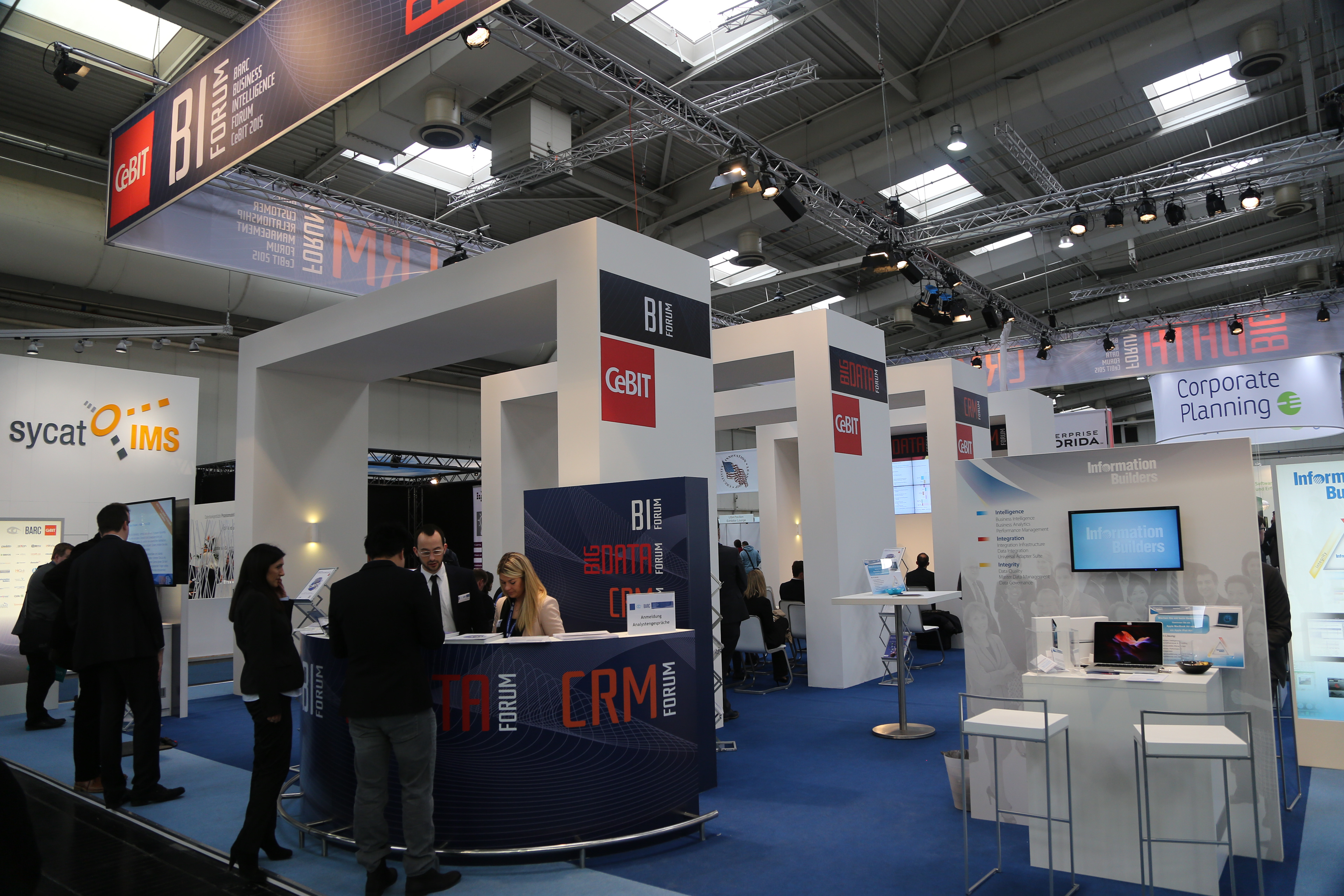
At the center, a circular information counter wrapped in branding becomes a natural gathering point. People lean in slightly as they talk, heads angled toward tablets and printed sheets, the body language unmistakably professional but not stiff—this is business, yes, but business with curiosity. Suits mix with smart-casual jackets, conference badges catch the light as attendees shift their weight from one foot to the other, waiting their turn. The signage above and around the booths layers the space with meaning: analytics, CRM, data, planning, intelligence. None of it shouts. It’s all presented with that understated confidence common to industrial and manufacturing ecosystems where reliability matters more than spectacle.
What really stands out, though, is how the scene balances human presence with engineered structure. The booths are tall and rectilinear, almost architectural fragments, while the people move fluidly between them, creating a quiet rhythm of motion—stop, talk, gesture, nod, move on. Screens glow softly with dashboards and interfaces, hinting at complex systems reduced to legible visuals for decision-makers passing through. In the background, more stands recede into the hall, suggesting the sheer breadth of the event beyond the frame. It feels like a crossroads of manufacturing’s present and near future, captured mid-flow, slightly imperfect, slightly busy, exactly as a global trade fair should be.
Upcoming tech events:
- Hannover Messe: Trade Fair for the Manufacturing Industry, 20–24 April 2026, Hannover, Germany
- DesignCon 2026, Feb. 24–26, Santa Clara Convention Center
- NICT at Mobile World Congress 2026, March 2–5, Barcelona
- Sonar Summit: A global conversation about building better software in the AI era, March 3, 2026
- Cybertech 2026: Proof That the Industry Is Finally Catching Up With Reality
- Chiplet Summit 2026, February 17–19, Santa Clara Convention Center, Santa Clara, California
- MIT Sloan CIO Symposium Innovation Showcase 2026, May 19, 2026, Cambridge, Massachusetts
- Humanoid Robot Forum 2026, June 22–25, Chicago
- Supercomputing Asia 2026, January 26–29, Osaka International Convention Center, Japan
- Chiplet Summit 2026, February 17–19, Santa Clara Convention Center, Santa Clara, California