Maximilien Luce and the Street After the Killing
There is a wall label just visible at the left edge of this frame. It says 1871. That year is doing a lot of work.
The painting is Maximilien Luce’s Une rue à Paris en mai 1871, completed around 1903–06 — more than thirty years after the events it depicts. Luce was seven years old when the Versaillais troops swept back into Paris and ended the Commune in what became known as la Semaine sanglante, the Bloody Week. Somewhere between ten thousand and thirty thousand Communards were killed in seven days. The bodies were left on the cobblestones.
What Luce painted is the aftermath of a street execution. Several soldiers in the dark blue of the French line infantry lie dead in the foreground — they are Communard fighters, not Versaillais regulars, though the distinction barely registers visually. Alongside them, a woman in a dark skirt. One figure alone in the middle distance, already receding into the empty street. The shopfronts are closed, shuttered, indifferent in their Haussmann solidity. A shaft of morning light crosses the cobbles. The city is otherwise empty.
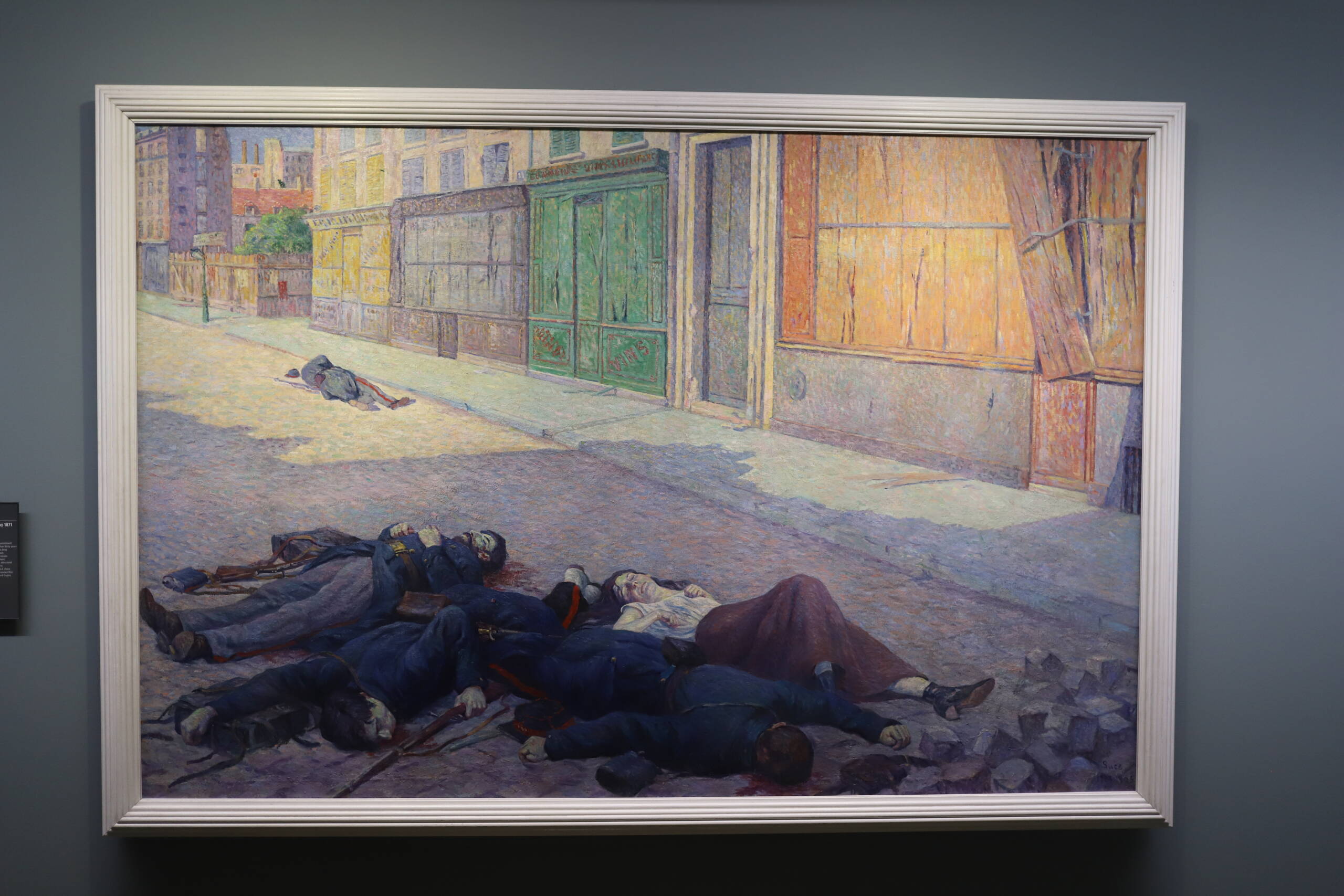
The technique is Neo-Impressionist — the Pointillist mosaic Luce developed alongside Seurat and Signac — and it creates an almost unbearable dissonance. The dots of color, the luminous, broken surface that usually signifies leisure, parks, river bathing, Sunday afternoons, here registers mass death. The light is beautiful. The bodies are factual.
Luce was a committed anarchist his entire life. He knew some of the last surviving Communards personally. He did not paint this as journalism or as monument. He painted it as witness testimony, delayed by decades, delivered in a style that refuses to make the horror heroic or even conventionally dark. The palette is pastel. The composition is almost casual — figures distributed across the foreground like debris, not arranged for drama.
That casualness is the argument. This is what it looked like. A street. Some dead people. Morning light. Closed shops. The city moving on.
The painting now hangs in the Musée d’Orsay. It is not the most famous canvas in the building. It should be harder to walk past than it is.