What We Actually See in a Museum
A photograph taken in passing at the Kunsthistorisches Museum in Vienna. Three Flemish paintings on a gray wall: a wide peasant feast crowded with figures at the top, a dark hanging-carcass still life on the lower left, a market scene with a poultry seller on the lower right. One of them — the market scene — is confirmed Pieter Aertsen from the wall label. The others are probably from the same orbit: Aertsen, or Beuckelaer his nephew, or one of the other Antwerp painters working in the same genre tradition in the mid-sixteenth century. Probably. The wall labels were small and the room was busy.
This is, in fact, how most museum visits work. We receive impressions faster than we can verify them, and the curatorial arrangement does most of our thinking for us. Three paintings hung in proximity read as a group. A group implies a thesis. We absorb the thesis — Flemish genre, market and kitchen and feast, the material world as worthy subject — and move on without necessarily distinguishing which hand made which canvas. The attribution details, the dates, the provenance footnotes: these live in the catalog, which most visitors do not buy.
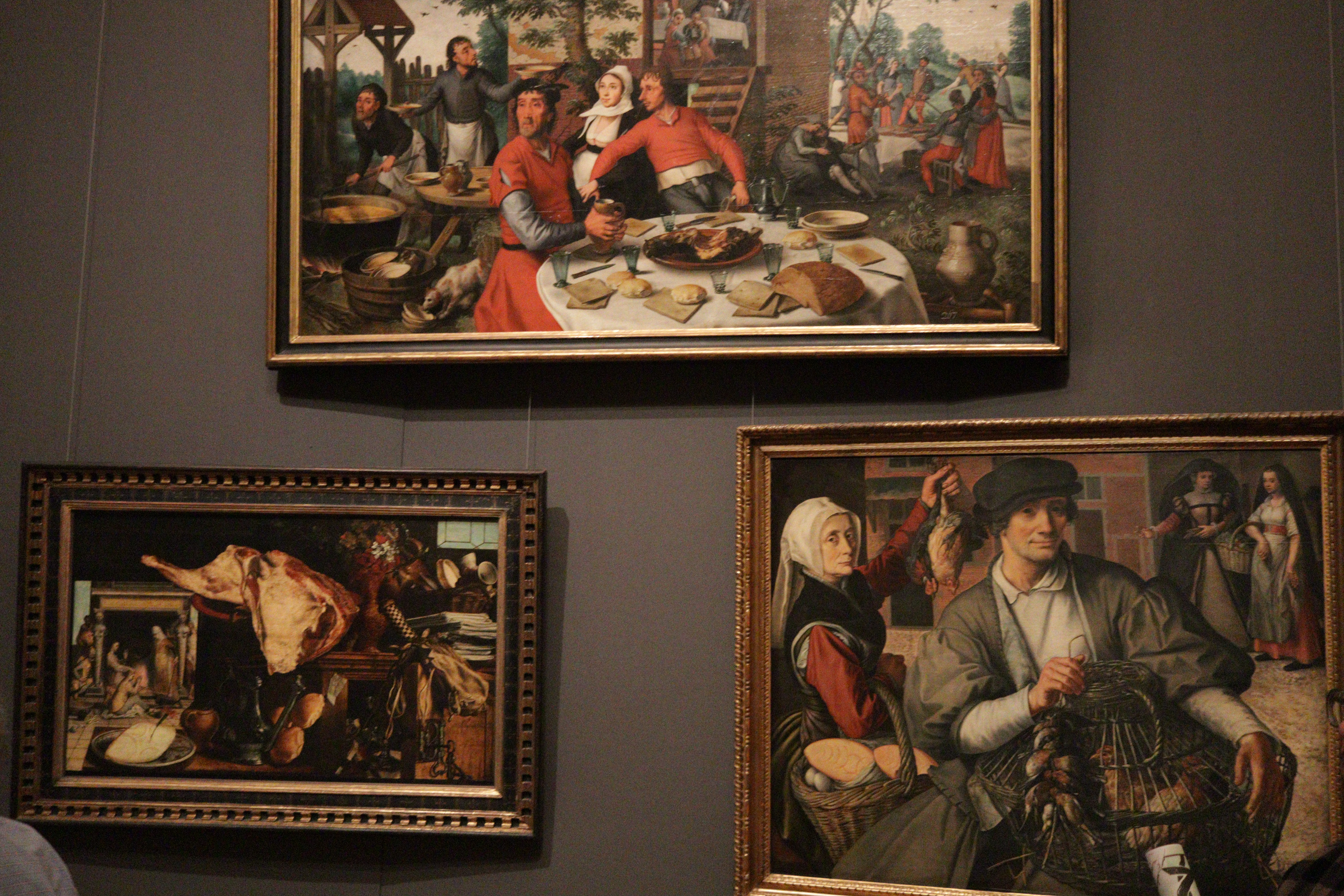
There is nothing wrong with this. The grouping carries real meaning independent of whether we can name each painter. Whoever made that carcass still life — and the dark, almost brutal handling of raw meat in it is striking enough to warrant individual attention — was working through the same problem Aertsen was: how do you paint a side of beef and make it feel like a serious statement rather than a curiosity? The answer these painters arrived at was to give it the same formal gravity previously reserved for sacred subjects. The meat hangs the way a crucified figure hangs. The birds in the cage press against the picture plane the way urgent things press. The feast table overflows with the same excess that appears in scenes of the prodigal son.
Museums group these works together because they share a genre logic and a rough historical moment. But the grouping also performs something for the viewer: it says that this tradition is coherent enough to occupy a wall, serious enough to deserve sustained attention, and various enough within its own terms to reward looking at each work rather than collapsing them into one impression.
Whether we actually slow down enough to do that looking is a separate question. Usually we don’t. The photograph is proof — three paintings absorbed in a single frame, the labels unread, the attributions uncertain, the impression vivid.