Michelangelo's David at Palazzo Vecchio Is a Copy: Why Florence Keeps It There
The marble standing at the door of Palazzo Vecchio has been there since 1910, and most of the people photographing it have no idea. Michelangelo’s David left the square in 1873, moved on rails through the streets to the Galleria dell’Accademia, where it now stands under a purpose-built skylight at the end of a ticketed queue. What replaced it is a copy by Luigi Arrighetti, set in the exact spot the original held for 369 years.
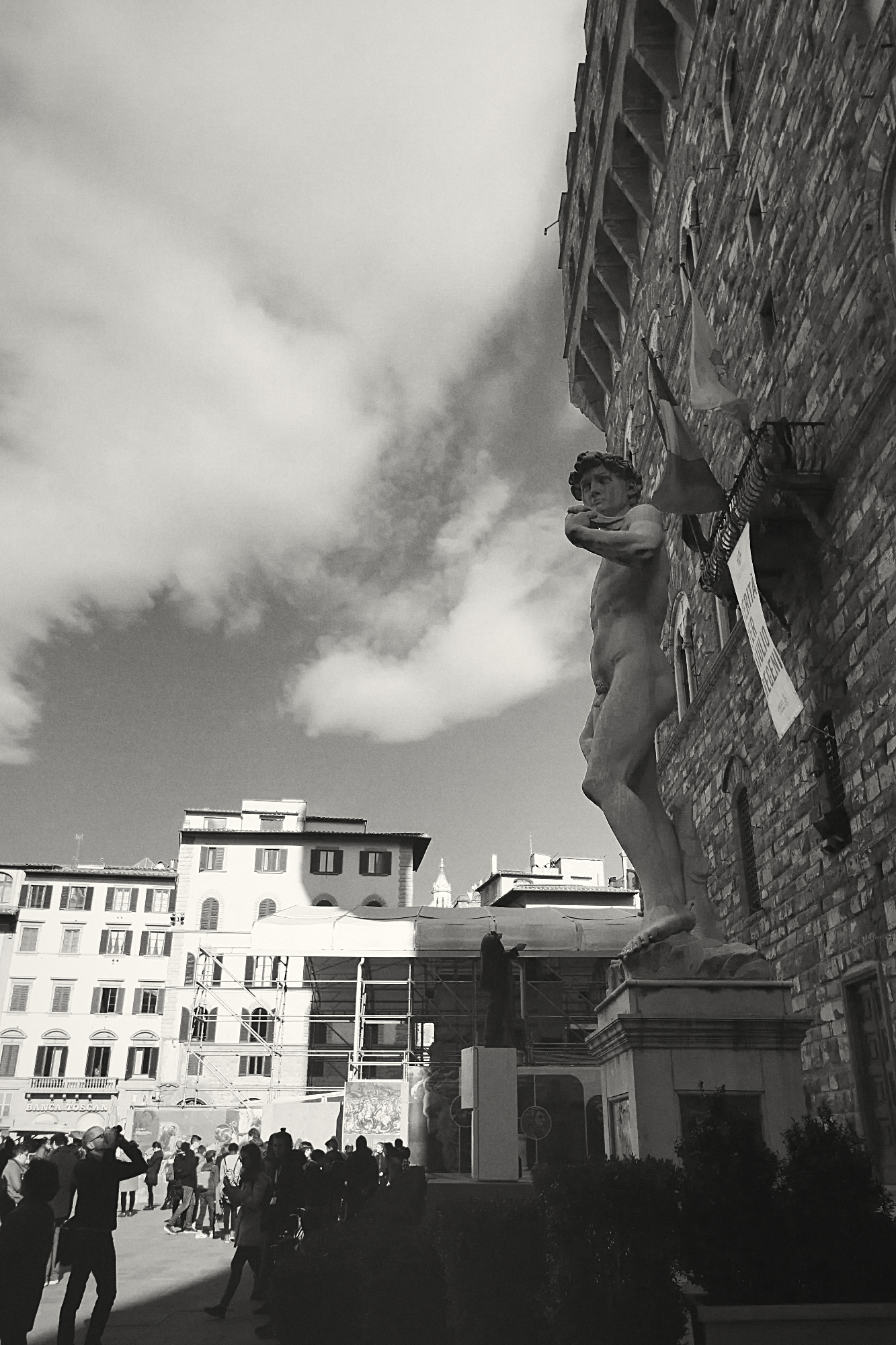
Calling it a substitute gets the situation backwards. For understanding what Michelangelo actually built, the copy is standing in the better place.
The Statue Was Made to Be Seen from Below
The block came out of Carrara for the cathedral. It sat in the Opera del Duomo workyard for decades after two earlier sculptors gave up on it, and when Michelangelo took it on in 1501 he was 26 and working toward a specific destination: a series of prophets planned for the buttresses of the tribune, high above the street.
That explains the proportions everyone notices and few explain. The head is too large. The hands are enormous, the right one especially, hanging heavy at the thigh. The neck is thick. Those aren’t quirks of style. They’re corrections for a viewer standing far below, looking up through a lot of air.
The statue never got to the buttress. When it was finished in 1504 a committee that included Leonardo, Botticelli and Giuliano da Sangallo argued over where to put it, and the decision was that something this good shouldn’t be parked 20 metres up where nobody could read it. It went to the platform beside the palace door instead, and Donatello’s Judith and Holofernes was shifted out of the way to make room.
So the compensations built into the carving were half-wasted from the start. Almost. Standing at the foot of the plinth in the square, craning up, you get a fraction of the effect back. The head settles. The hand stops looking like a deformity and starts looking like a threat.
What the Copy Keeps
Inside the Accademia the original sits in a rotunda, evenly lit from above, at a distance and angle the sculptor never planned for. It’s a magnificent thing to see and it is, in a precise sense, out of context. The gaze goes nowhere. In the piazza the gaze goes south, toward Rome, which is the whole civic argument the Florentine republic was making when it put a giant-killer at the door of its government building.
The copy inherits that. It gets the direction, the height, the raking afternoon light, the rusticated stone at its back, the flags, the noise. It sits inside the composition it was meant for.
What it can’t inherit is the surface. Michelangelo’s finish, the tool marks left visible on the tree stump and smoothed away on the chest, the faint translucency of good Carrara marble under strong light. That’s the reason the original moved indoors in the first place, along with the rain, the pollution, and the day in 1527 when rioters threw a bench out of an upper window of the palace and broke the left arm into three pieces. Vasari, then a teenager, helped collect them.
A Statue That Exists Mostly as Reproductions
David has been copied more thoroughly than almost any object in Western art. There’s a bronze version at Piazzale Michelangelo, plaster casts in academies across Europe, and a century and a half of prints, postcards and posters. The Victoria and Albert Museum’s cast came with a detachable plaster fig leaf, kept in a box and hung on hooks for royal visits.
Which raises the question the square itself answers. If a work is known almost entirely through its copies, what does the original still hold that the copies don’t?
Not the composition. Not the pose, the proportions, or the meaning. Those survive reproduction fine, which is why a photograph taken from the pavement in Florence still does the work.
What survives only in the marble is the hand of the man who cut it. That’s a real thing and it justifies the queue at the Accademia. But it isn’t the same thing as the statue, and the crowd in the square is not looking at a lesser object. They’re looking at the argument, in the place it was made.
The copy is doing the job. The original is being conserved.