Prague's Wenceslas Monument: 35 Years of Sculpture and a Century of Protest
Two words are legible on the granite from the pavement: SVATÝ VÁCLAVE. Saint Wenceslas, vocative case, the form you use when you are speaking to someone. The rest of the inscription runs around the pedestal and finishes as a request. Duke of the Czech land, our prince, do not let us perish, nor those who come after us. The line comes from a hymn that was already old in the fourteenth century, and it is carved on a monument finished in 1924, which tells you most of what you need to know about how Czechs have used this saint.
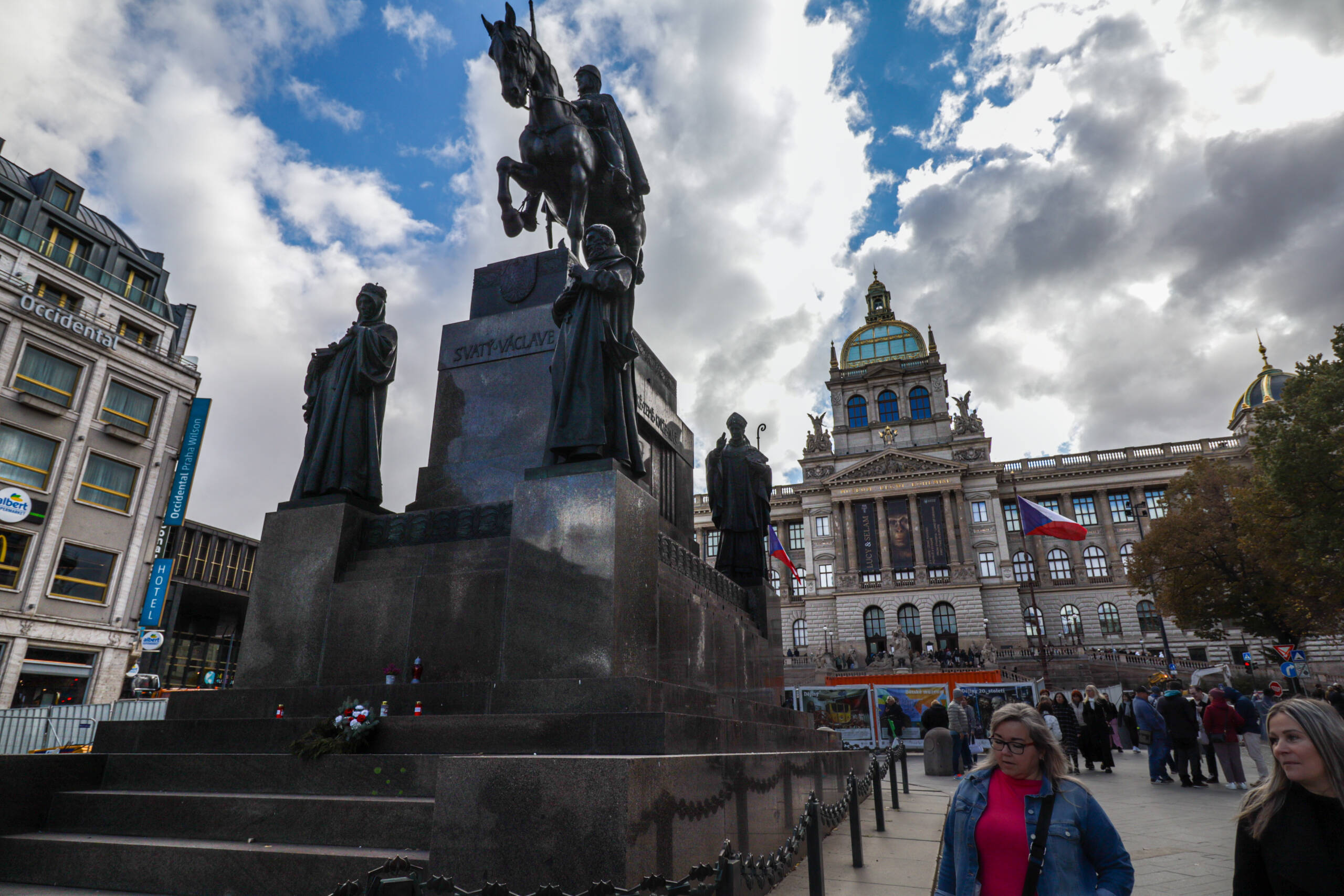
Josef Václav Myslbek worked on the thing for thirty-five years. He started modelling in 1887, before there was a competition, before there was a commission worth the name. When the public competition finally came in 1894 the jury refused to award a first prize and handed out two seconds, one to Myslbek and one to Bohuslav Schnirch. The two men had opposite ideas about who Wenceslas was. Schnirch wanted the pious duke, hand raised in blessing, banner of the Virgin. Myslbek wanted the soldier. You can see who won. The figure sits heavy in the saddle, lance held upright, helmet on, going somewhere.
The horse was modelled on an army stallion called Ardo. The equestrian group went up in 1912 and was unveiled in 1913, unfinished, because the saints at the corners were not ready and the sculptor was in his seventies. Myslbek died in 1922. The last two figures were installed in 1924.
Four saints doing political work
The corner figures are not decoration. Each one is a claim about where the Czech nation came from.
Front left, in the crown and veil, is Ludmila, Wenceslas’s grandmother, the woman who had him raised as a Christian and was murdered for her trouble. Front right, the bearded man with the book, is Prokop, abbot of Sázava, the Slavonic-rite monastery. Myslbek gave Prokop his own face. Behind them stand Agnes of Bohemia, a king’s daughter who refused two royal marriages and founded a convent instead, and Adalbert, second bishop of Prague, who left the city in frustration and was killed by pagans on the Baltic coast.
Grandmother, monk, princess, bishop. Dynastic legitimacy, Slavonic liturgy, native sanctity, and the church. Celda Klouček did the bronze friezes and the Wenceslas eagle on the base, and Alois Dryák designed the granite. Everything on the pedestal is an argument, assembled in stages over a decade and a half, in a city still governed from Vienna.
The square was a horse market
Until 1848 this was Koňský trh, the horse market, a long sloping trading space laid out by Charles IV in the 1340s. It was renamed during the revolutionary year at the suggestion of Karel Havlíček Borovský, and the renaming was itself a nationalist move. The statue arrived in 1912. The state it stands for arrived in 1918.
After that the square never stopped being used. Crowds gathered here for the declaration of Czechoslovak independence. German troops came up it in 1939. The Communists took the country in 1948. In August 1968 Soviet tanks stopped in front of the museum and shot the façade. In January 1969 a student named Jan Palach set himself alight near the top of the square in protest at the occupation and the resignation that followed it; he died three days later, and Jan Zajíc did the same a month afterwards. In November 1989 several hundred thousand people filled the space between the monument and the bottom of the square, and Havel and Dubček spoke to them from a balcony halfway down.
The candles and the wreath on the steps in the photograph are for Palach and Zajíc. The memorial is at the foot of the pedestal and people keep it lit. This is normal here. Nobody stages it.
The building behind
The National Museum closes the square at the top. Josef Schulz built it between 1885 and 1891 in a neo-Renaissance style meant to read as a temple rather than an office, and its position is deliberate: the whole boulevard funnels your eye up the slope to the ramp and the pediment. The 1968 gunfire left the sandstone pocked. Repairs used lighter stone, and the patches were left legible on purpose, so the façade still carries the record. The building closed for a long reconstruction and reopened in 2018, on the centenary of the republic.
In the frame it is flying the state flag and advertising a hominin fossil exhibition. The two things sit side by side without any tension at all, which is the ordinary condition of a national monument that people also walk past on the way to work.
Prague has an answer for that. Ask a Czech where to meet and they will say u koně. At the horse.