Photo of the Day: November 8, 1291
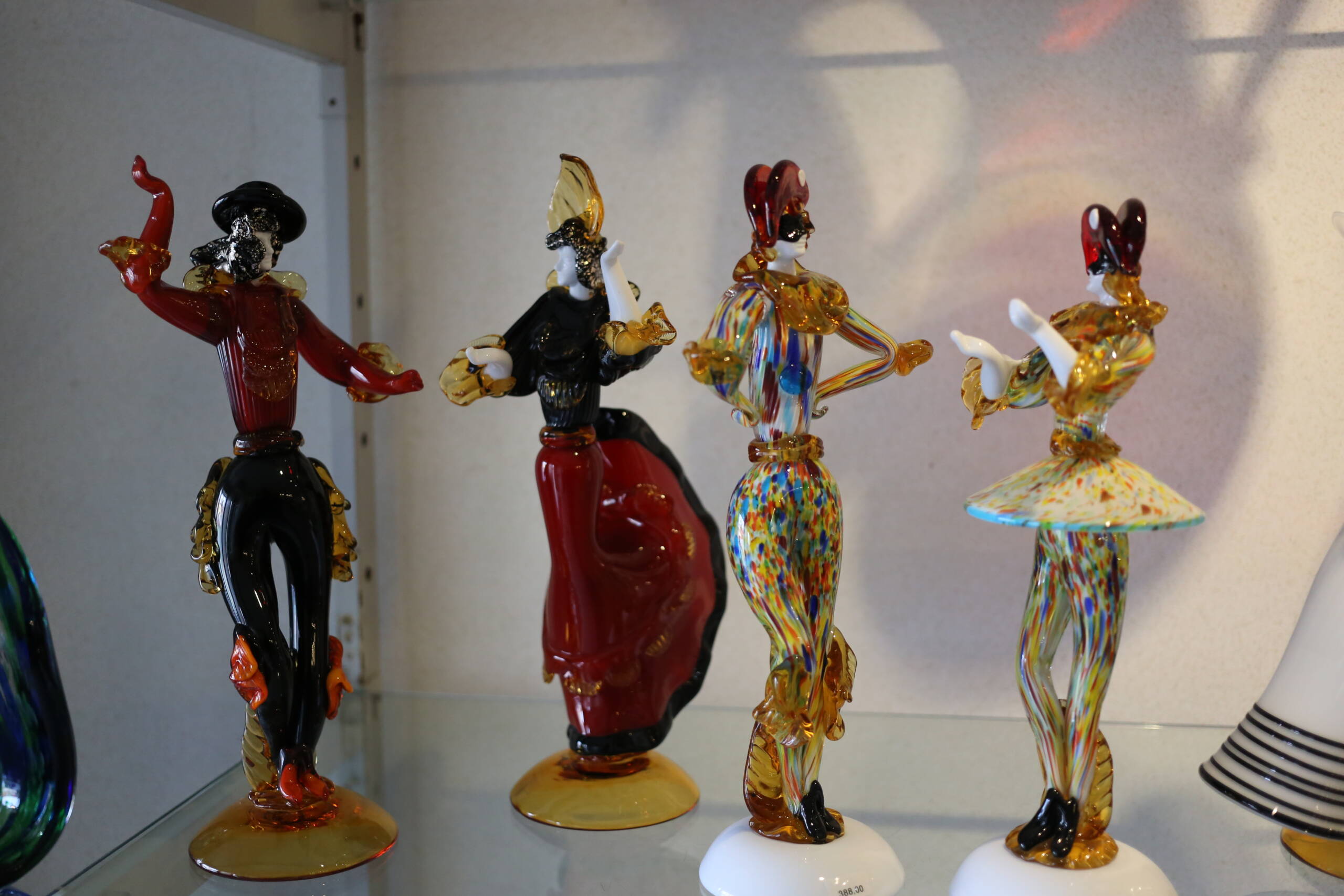
Four Murano glass Carnival figurines on a showroom shelf — Harlequin in black and amber, a dancer in deep red, a jester in millefiori, a fourth in swirling multicolor. The craft in each piece is genuine. The price tag on the rightmost reads €188.30.
On November 8, 1291, the Venetian Great Council issued a decree ordering every glassmaker in the city to relocate to the island of Murano. The stated reason was fire risk — Venice was largely built of wood and furnaces burned at over 1,500°C. A single accident could take a neighborhood with it, and there had already been several. The real reason was control. The glassmakers knew things too valuable to let circulate freely: how to produce cristallo, the optically clear glass no one else in Europe could match; how to pull filigrana threads into swirling lattice patterns inside a vessel wall; how to fuse millefiori canes into the mosaic blooms that looked, up close, like something that shouldn’t be possible in glass at all. An island in the lagoon was easier to police than a city. Those who left without permission faced death. Those who stayed were given swords, noble marriages, immunity from prosecution by the Venetian state, and the right to mint their own coins. Gilded captivity, Venetian-style. The Republic had, in a single decree, invented the world’s first protected designation of origin — and enforced it with assassins.
The arrangement held for centuries, imperfectly. Some masters fled anyway, carrying their knowledge to France, England, the Netherlands, Bohemia. The Bohemian crystal industry that emerged in the 17th century and nearly destroyed Murano’s monopoly traces its origins partly to those defections — men who weighed death against freedom and chose to run. One of them, according to legend, ended up at the court of Louis XIV and taught French glassmakers the techniques that produced the Hall of Mirrors at Versailles. Seventy-three meters of Venetian fire, repackaged as French splendor. The original craftsmen were never credited. That too is part of the tradition.
What you are looking at on this shelf is the long tail of all of that. The Harlequin figure in black and amber is a Carnival character, which means it draws on a theatrical tradition that Venice also packaged and exported — the Commedia dell’Arte, the masked archetypes that traveled across Europe and became the ancestors of everything from Punch and Judy to modern clown performance. Harlequin is a servant playing a fool playing a schemer. The glass version is a servant playing a souvenir. The millefiori jester, third from the left, uses a technique that was rediscovered in the late 19th century after being essentially lost — revived not from living practice but from the study of antique pieces, like archaeologists reconstructing a language from fragments. The craft is real. The continuity is more complicated.
There is a version of this shelf that is a magnificent souvenir. Four objects that carry, embedded in their structure, seven centuries of accumulated technique — the cristallo formula, the filigrana pull, the millefiori cane work, the Carnival mask tradition — all of it compressed into something you can wrap in tissue paper and carry home in a tote bag. At €188 a piece that is not unreasonable. At €188 a piece it is also exactly what the Republic of Venice designed the whole system to produce: a controlled, premium, export-ready product with a geographic monopoly baked in by law. The decree of 1291 is still doing its work. The island is still the island. The showroom is still the showroom. More on that gap: Murano and Burano Are Beautiful for About Five Minutes.