Poland Under Martial Law: December 1981 Situation File
Status: Closed file. Martial law imposed 13 December 1981, suspended 31 December 1982, formally lifted 22 July 1983. Legal reckoning incomplete.
Subject: The imposition of martial law in the Polish People’s Republic, the machinery used to enforce it, and the disputed justification behind it.
Background
Solidarity was legalised in the autumn of 1980 under the Gdańsk Agreement, and within a year it had somewhere close to ten million members in a country of thirty-six million. No communist state had ever conceded an independent mass organisation on that scale. The party’s authority inside workplaces effectively collapsed.
The economy collapsed alongside it. Poland owed roughly $25 billion in hard currency to Western creditors, meat had been rationed since April 1981, and industrial output was falling through the year. Queues were the organising fact of daily life.
Wojciech Jaruzelski became prime minister in February 1981 and first secretary of the party on 18 October, while keeping the defence ministry. He held all three posts on the night the tanks moved.
Planning had been running in parallel since the winter of 1980. Most of the legal instruments were drafted by early September 1981. To keep the preparations out of Polish printing houses, 25,000 posters announcing martial law were printed in Moscow.
The immediate trigger was a Solidarity national commission meeting in Gdańsk on 11 and 12 December, where speakers called for a referendum on the party’s leading role and on free elections to the Sejm. The security services were listening. The final order went out around midday on 12 December.
The night of 12 to 13 December
Telephone and telex lines went dead across the country. Internment teams began work after midnight. By the time Jaruzelski appeared on television on Sunday morning in dress uniform, most of the Solidarity leadership was already in custody.
Power was vested in the Military Council of National Salvation, WRON, twenty-one officers chaired by Jaruzelski. The acronym reads almost as wrona, crow, which produced the underground slogan about the crow never defeating the eagle.
The legal basis was defective from the first hour. The Council of State issued the decree overnight, but under the 1952 constitution it could only legislate between Sejm sessions, and the Sejm was sitting. The Sejm ratified the decree in January 1982.
Initial deployment ran to roughly 70,000 to 80,000 troops, around 30,000 militia, some 1,750 tanks and about 1,900 armoured vehicles.
Key actors
Wojciech Jaruzelski. Prime minister, first secretary, defence minister, WRON chairman. Defended the operation for the rest of his life as the lesser of two evils.
Czesław Kiszczak. Interior minister from July 1981, previously head of military counter-intelligence. Ran the internment programme. Seven years later he sat across the table from the same men at the Round Table.
Florian Siwicki. Chief of the general staff, Jaruzelski’s deputy in Moscow negotiations.
ZOMO. The Motorised Reserves of the Citizens’ Militia, the regime’s riot formation, better paid and better fed than the regular militia. The instrument of every pacification through the decade.
SB. The security service, running surveillance, informer networks and the internment lists.
Solidarity. Lech Wałęsa was isolated at a government villa in Arłamów rather than in a camp, which the authorities intended as an offer. He refused to negotiate. An underground coordinating commission formed in April 1982 around Zbigniew Bujak, Władysław Frasyniuk, Bogdan Lis and Władysław Hardek.
The Catholic Church. Primate Józef Glemp counselled against confrontation. John Paul II raised Poland during his Angelus on 20 December 1981 and returned on pilgrimage in June 1983, which the regime allowed and could not control.
Moscow. Brezhnev, Andropov, Suslov, and Marshal Viktor Kulikov as Warsaw Pact commander.
Washington. Reagan suspended Polish landing rights and export credits within days.
Instruments
Internment was carried out under the codename Jodła, fir. The seizure of communications and broadcasting ran under Azalia.
The enforcement regime included a curfew from 22:00 to 06:00, a ban on movement between voivodeships without a permit, the closure of schools and universities, the suspension of every social organisation, and the shutdown of all publications except the party daily and the army daily. One television channel remained. Journalists were screened for loyalty and thousands lost their accreditation.
Key enterprises were militarised. Military commissars were installed, and workers in those plants came under military discipline, which made a strike a criminal offence tried by summary procedure. Mail was censored. When phone service resumed, calls opened with a recorded voice announcing that the conversation was being monitored.
Repression: the figures
More than 3,000 people were detained on the first night, rising to about 5,000 within the first week. Across the whole period roughly 10,000 people were interned in some forty-nine centres, including a camp at Gołdap in the north-east that held women.
The courts did the rest. Common courts convicted 1,685 people for politically motivated offences, 979 of them under the martial law regulations. Military courts convicted 10,191, of whom 5,681 were sentenced under the decree itself.
Death tolls vary because the counting rules vary. The figure commonly given for the period is around ninety, though narrower definitions limited to killings directly attributable to the security forces produce something closer to forty. Neither figure captures the deaths from denied medical care, nor the murders that followed the formal end of martial law.
Wujek
On 16 December 1981 the Wujek colliery in Katowice was still occupied by striking miners. Armour breached the wall and a ZOMO special platoon opened fire. Six miners died at the scene and three more died of their wounds. Twenty-one were injured.
It was the bloodiest single episode of martial law, and it settled the question the strikers had been arguing about all weekend. The regime would shoot.
Jaruzelski’s calculus
The general’s defence never changed. Martial law, he argued, pre-empted a Soviet invasion that would have cost far more lives, and a Polish crackdown was preferable to a Warsaw Pact one.
The archives make that harder to sustain. At the CPSU Politburo session of 10 December 1981, three days before the declaration, the discussion turned on Jaruzelski’s request for a guarantee of military support if the operation failed. Grishin stated flatly that there could be no talk of sending in troops. Andropov had confirmed the same position at the end of October. Accounts from Polish and Soviet participants have Suslov telling Jaruzelski not to expect Soviet military help under any circumstances. Moscow’s irritation in the transcript is with a Polish leader who kept making his crackdown conditional on a promise the Politburo had already refused to give.
Two qualifications belong in the file. Soviet decisions were reversible, as Hungary in 1956 demonstrated, and a Politburo that had said no in December had said no before Budapest as well. And Moscow held levers short of invasion, principally oil and raw material deliveries into an economy that had nothing to spare.
A colder reading of the same evidence is that Jaruzelski was trying to obtain a guarantee, was refused, and went ahead regardless because what was at stake was the party’s monopoly and his own position at the top of it. The published Kulikov material, which the general disputed until his death in 2014, points that way.
Aftermath
Solidarity was formally delegalised on 8 October 1982. It continued underground with a clandestine press, a coordinating commission that survived repeated arrests, and a broadcast operation.
Martial law was suspended at the end of 1982 and lifted in July 1983. Amnesties followed in 1984 and 1986, though the machinery outlived the emergency. In October 1984 officers of the security service abducted and murdered Father Jerzy Popiełuszko, whose sermons had become a focal point for the opposition. His funeral drew hundreds of thousands.
The economic squeeze never lifted. The United States suspended most-favoured-nation status and blocked Poland’s IMF application, restoring trade status only in 1987. By 1988 a new strike wave forced the regime back to the table. The Round Table talks ran from February to April 1989, the partly free elections of June 1989 destroyed the party’s candidates, and Poland had a non-communist prime minister by September.
The legal accounting has been slower. A Sejm commission found in 1992 that the imposition had violated the constitution. The Constitutional Tribunal ruled in 2011 that the decrees were unlawful. Prosecutors classified WRON as an organised criminal group, and Jaruzelski went on trial in 2008, but the proceedings were repeatedly suspended for his health and he died in 2014 without a verdict. Kiszczak received a suspended sentence in 2012.
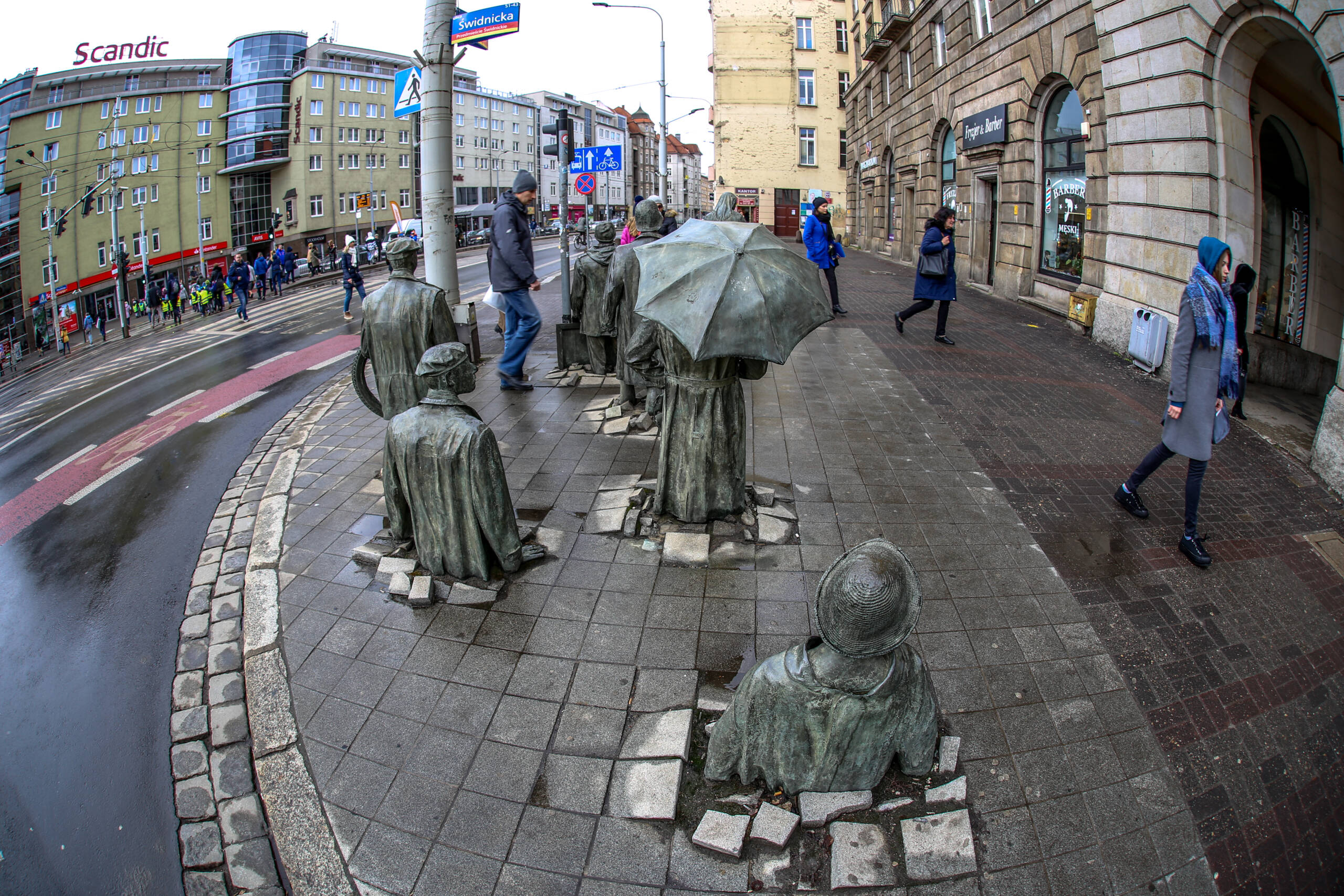
Poland marks 13 December every year. In Wrocław, at the corner of Świdnicka and Piłsudskiego, Jerzy Kalina’s installation of 2005 has a group of bronze pedestrians sinking into the pavement on one side of the road and climbing back out on the other.
Assessment
The operation was a military success and a political failure, and the two are connected. It worked because it was planned for a year and executed against an opponent that had no plan for the night it came. It failed because breaking an organisation is not the same as recovering the authority to govern without one.
The regime bought itself eight years. It spent them negotiating, from a weakening position, with the people it had interned in December 1981, and it handed power to them at the end. Everything the party gained that night, it gave back with interest.