Wrocław's Rebuilt Square and Kraków's Peasant Costume Are Both Younger Than They Look
A brown horse stands in harness on the cobbles of the Wrocław Rynek, waiting for a fare that has not arrived yet. Behind it the Old Town Hall shows its east face, the gilt gable with its blind tracery, the astronomical dial with its gold sun, the stepped brick pinnacles running up either side. A kiosk sells souvenirs from a doorway at the base. A few people sit on the steps of the pillory column. It reads as one of the most convincingly medieval squares in central Europe, and most of what you are looking at is younger than the horse’s grandmother.
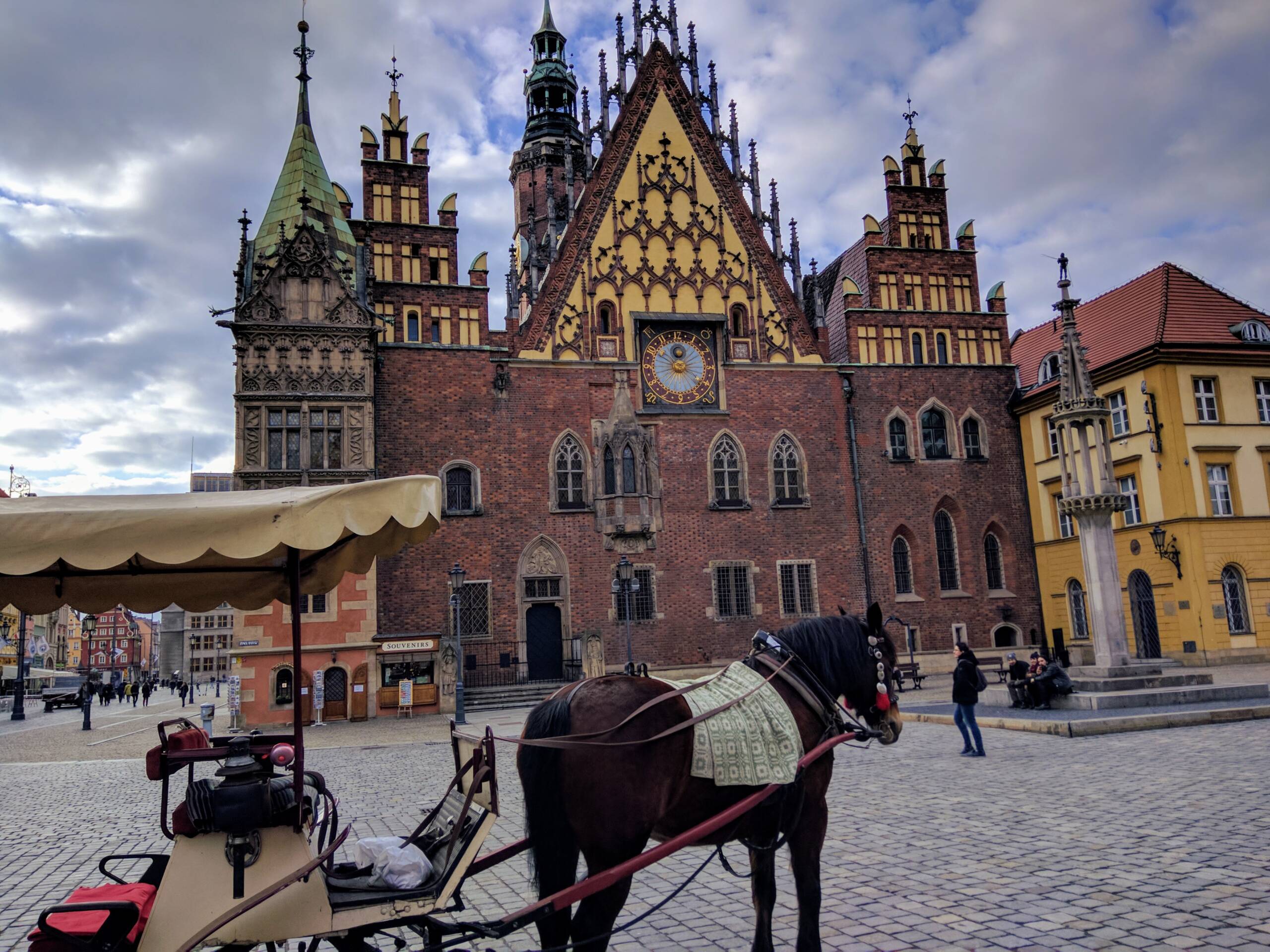
The town hall itself is the real thing. It went up in stages between the thirteenth and sixteenth centuries, and the clock dial dates to 1580. It came through the war standing. Almost nothing around it did.
A square rebuilt by people who had just arrived
Breslau was declared a fortress city in early 1945 and held out under siege until May, surrendering days after Berlin. Something like two thirds of the built fabric was gone by the end. The German population that had raised those buildings left or was expelled over the following two years, and the city filled up with Poles moved west out of territories that had become Soviet, a great many of them from Lwów.
Those settlers inherited a ruined German Gothic and Baroque city centre and set about putting it back. The townhouses along the Rynek were reconstructed through the fifties and sixties from photographs, old paintings, measured drawings, and in some cases informed guesswork about what a façade had probably looked like before somebody remodelled it in the nineteenth century. Some were rebuilt faithfully. Some were given back a period appearance they had lost long before the bombing. A few are essentially new buildings wearing an argument about the past.
None of this makes the square false. It does make it a decision rather than an inheritance.
The costume in the second photograph is also a decision
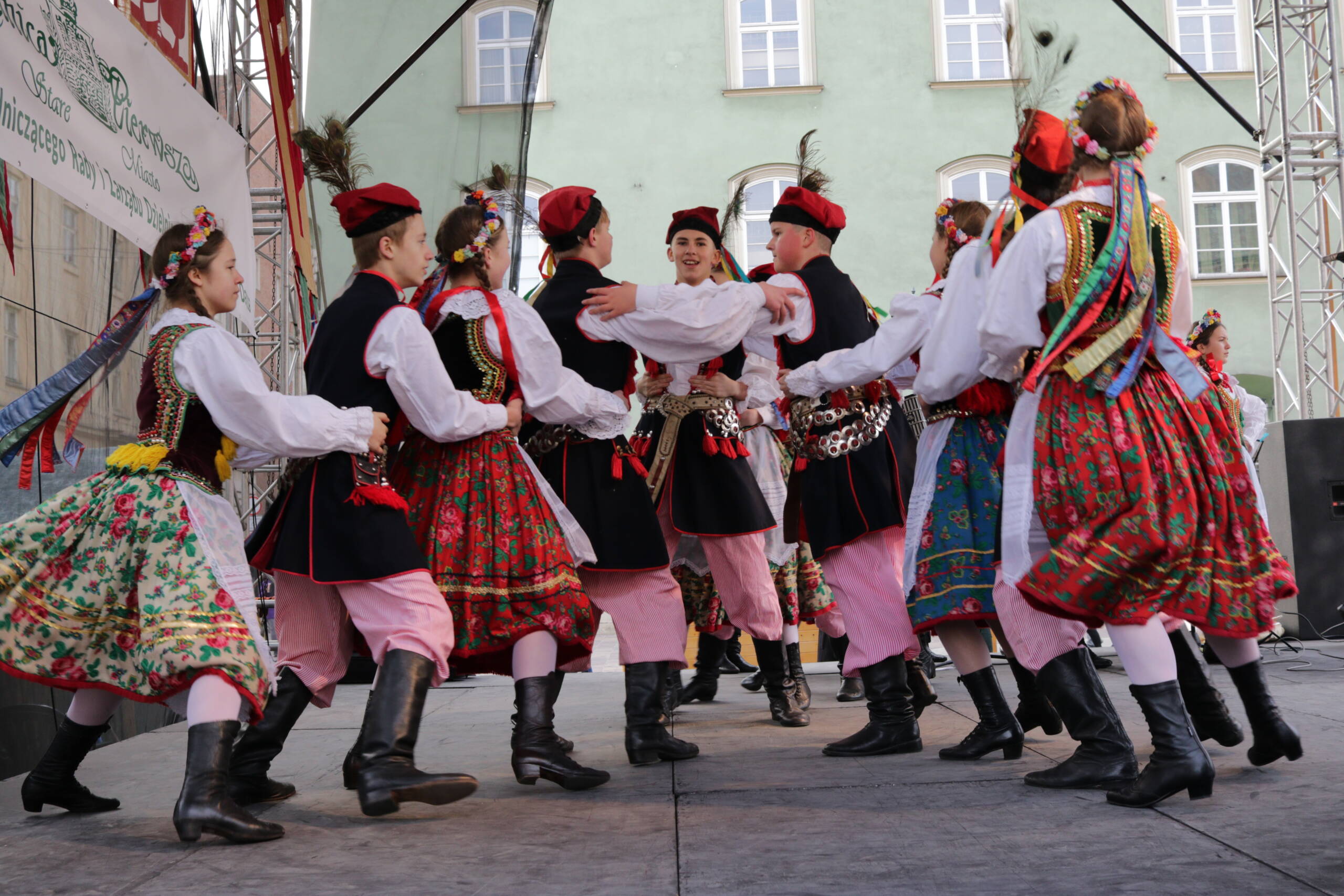
Teenagers dance a circle on a temporary stage under a district council banner. Red four-cornered caps with peacock feathers, white blousy sleeves, black waistcoats with metal studs, wide floral skirts, striped trousers, tall boots. This is the krakowiak set, the dress of villages around Kraków, and for most of the world it is simply what Polish traditional clothing looks like.
It did not start out as a national costume. It was one region’s peasant clothing among dozens, and Poland has plenty of others that look nothing like it. What happened is that in 1794 Kościuszko put on a peasant sukmana and led scythe-armed farmers from exactly this district against Russian troops at Racławice. The uprising failed. The image did not. Through the partitions, when there was no Polish state to be loyal to, painters and poets kept returning to the peasant in the four-cornered cap as the figure who had fought for a country that had been erased, and the outfit acquired a meaning far larger than the villages it came from. The postwar state then put that meaning into mass production through large sponsored ensembles, and the touring circuit and the diaspora clubs carried it everywhere else.
So a district dress became a flag. Same process as the square, running on a different clock.
The two photographs meet in a rotunda in Wrocław
Here is the part that closes the loop.
In 1893 two painters in Lwów, Jan Styka and Wojciech Kossak, began a panoramic canvas for the hundredth anniversary of the battle. It runs 114 metres around and 15 metres high, and it shows those scythemen charging Russian lines in the costume the teenagers on that stage are wearing. It opened in a purpose-built rotunda in 1894 and became the biggest attraction in the city.
After the war, Lwów became Lviv and stayed on the Soviet side of the new border. The panorama was rolled up and moved to Wrocław in 1946 along with part of the Ossolineum library collection, travelling with the same displaced population that was then rebuilding the Rynek. It arrived in a wrecked German city carried by people who had lost their own.
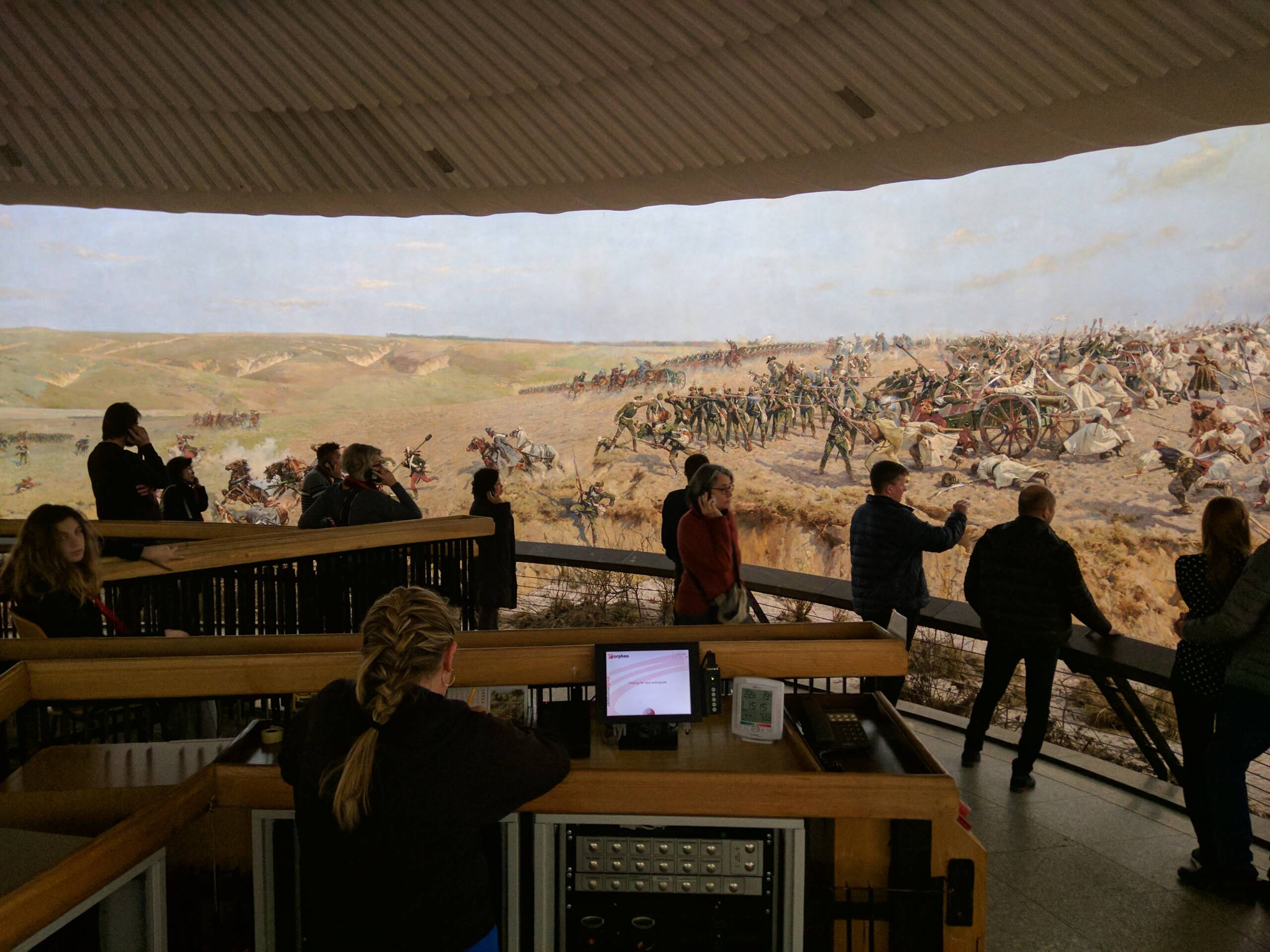
Standing on the platform in the middle of it, the thing that gets you is the join. The floor of the rotunda is built up into artificial terrain, real sand and dry grass and broken cart wheels, and at some point a few metres out that terrain becomes paint. You cannot find the seam. The light is managed so the horizon reads as sky rather than canvas, and the whole apparatus was designed in 1893 to do a job that photography could not yet do and cinema had not yet been invented to take over. It is a nineteenth-century immersive medium still running on its original hardware, with an audio guide desk bolted to the platform railing.
Then it sat in storage for nearly forty years. A vast painting celebrating a Polish victory over a Russian army was not something the authorities wanted on public view. Volunteer committees pressed for it repeatedly and got nowhere. The rotunda to house it was finished in 1967 and stood empty of it. Only after August 1980 did permission come through, and the panorama finally opened to visitors on 14 June 1985. It now draws around 400,000 people a year and is the National Museum’s best-attended exhibition.
What this is actually worth
The easy reading of both photographs is that they show tourism dressed up as heritage. A carriage for hire in a reconstructed square, children in nineteenth-century clothes performing for a district council. Manufactured authenticity, priced by the hour.
That reading is lazy, and the panorama is why.
The people who rebuilt that square had no ancestral claim on it. They were housed in somebody else’s ruined city by a border they did not draw, and they chose to restore a Gothic and Baroque centre built by Germans rather than clear it and start again. They brought with them a painting of peasants from a different part of Poland fighting a battle in 1794, and they waited four decades to be allowed to hang it. Everything in both images was picked up rather than handed down.
A tradition you take up deliberately, and then keep doing for eighty years, is a tradition. A square you rebuild from photographs, and then live in for three generations, is your square. Continuity of stone and continuity of bloodline are the weakest tests of whether a place is real. Use is the strong one.
The horse is still waiting. The dancers already know the steps.