Taobuk and the Infiorata: Two Kinds of Public Culture in One Taormina Square
A red banner hangs off the stone face of Palazzo Corvaja. Three letters, a circle, and taobuk.it printed small at the bottom. Under the ficus trees to the right, a broadcast van in the livery of the Gazzetta del Sud group has its awning out and its cables run across the paving. A reporter stands in the open with a microphone and a sheet of notes while the cameraman frames him against the crenellations. Twenty metres away, on the far side of the same square, four people are kneeling on the ground pushing coloured petals into a pattern with their hands.
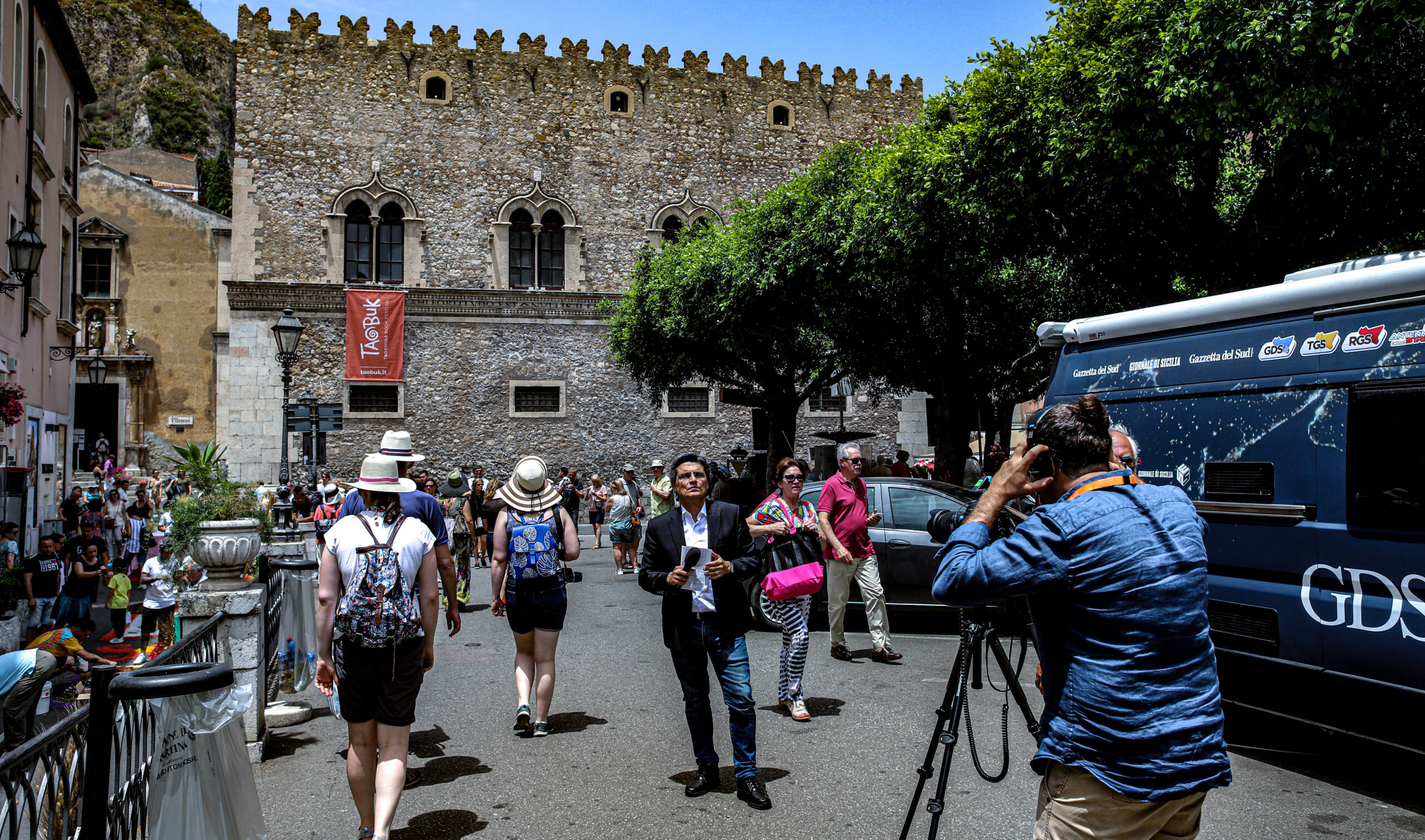
Both of those are culture. They are not the same kind of thing at all.
The festival is addressed outward
Taobuk was founded in 2011 and is conceived and directed by Antonella Ferrara. It runs for five days every June and it is built for reach. The sixteenth edition took the theme of Fiducia, trust, and brought more than two hundred guests from over thirty countries into a town of about ten thousand people. The programme covers literature, philosophy, economics, science and film, and it ends at the Teatro Antico with a gala and an awards presentation staged against the sea.
Everything about that is designed to travel. There is a manifesto, a visual identity, a theme word that can be translated into press copy in six languages. Regional television sets up in the square because the square is telegenic and flat and near the top of the Corso. The audience in Taormina is a small fraction of the audience being served. The rest of it is watching later, or reading about it, or seeing the town’s name attached to a Nobel laureate’s face in a photograph.
The flower carpet is addressed to the people making it
The infiorata is laid for Corpus Domini. The date moves with Easter, so it lands where it lands, and the work is done on the day by whoever turns up with buckets. Petals get sorted by colour, a design is chalked or templated onto the paving, and the pattern gets filled in by hand while the sun cooks the street. Then it is walked over. That is the point of it. The thing is made in order to be destroyed by the procession that passes across it, and by evening the street is swept.
No one is filming that with a shoulder rig. It has no theme word and no sponsor logos, and it does not need either, because it was never trying to reach anyone who was not already there. The value sits entirely in the doing.
The square holds both without any strain
What is easy to miss in the picture is how ordinary the coexistence looks. Nobody has cordoned anything off. The tourists in sun hats walk through the reporter’s shot without slowing down. The people on their knees in the petals are working two steps from a satellite van. A festival that exists to project the town outward and a ritual that exists to bind the town to itself are sharing about fifty metres of paving on a Thursday afternoon, and neither one is being staged for the benefit of the other.
Small places are usually asked to choose. The pitch is that heritage brings visitors, visitors bring money, and the price is that the heritage slowly turns into a performance of itself. Taormina has been living with that bargain for well over a century, since the Germans and the English started coming for the theatre and the climate, and it has plenty of the bad version on display along the Corso.
But this square on this day is the good version, and it works because the two things want different things. The festival wants cameras. The infiorata wants hands. There is no competition for the same resource, so the fight everyone predicts does not happen.
What the picture is actually evidence of
A town that can host an international literary festival and a parish flower carpet in the same hour has not been fully converted into a product. Something is still being done for local reasons on a local calendar, with no expectation that anyone outside will notice or care.
That is the part worth watching over the next decade, and it is measurable in a rough way. Count how many of the things a place does in public are still done when the cameras are elsewhere. In Taormina in June, the answer is at least one, and it was being walked over by the end of the day.