The Lloyd's Building Turns 40: Built to Keep Changing, Now Legally Fixed in Place
On a November morning in 1981 the Queen Mother poured concrete into a column form on Lime Street. It was the sort of ceremony that earns a photograph and a paragraph in the trade press. It was also the start of the strangest office building in London, and the start of an argument that has still not been settled forty years after the underwriters moved in.
Lloyd’s had run out of room. It ran out of room roughly every generation, which is why the market had already worked its way through seven previous homes. In 1978 it held an international competition for the eighth, with one instruction that mattered more than the rest: build something that will still work in the next century. Richard Rogers won it. He was fresh off the Pompidou in Paris, a building that had made him famous mostly by making people angry.
The demolition alone took sixteen months. Cooper’s 1925 headquarters came down between October 1979 and February 1981 while the underwriters shuffled piecemeal into temporary quarters. Construction started that June. The building topped out in May 1984 and was occupied in May 1986, eight years after the competition, at a cost of around seventy-five million pounds. The Queen opened it. The reviews were not kind. Critics reached for an oil rig, a coffee percolator, a motorcycle engine, and a patient on life support.
The Argument for Turning a Building Inside Out
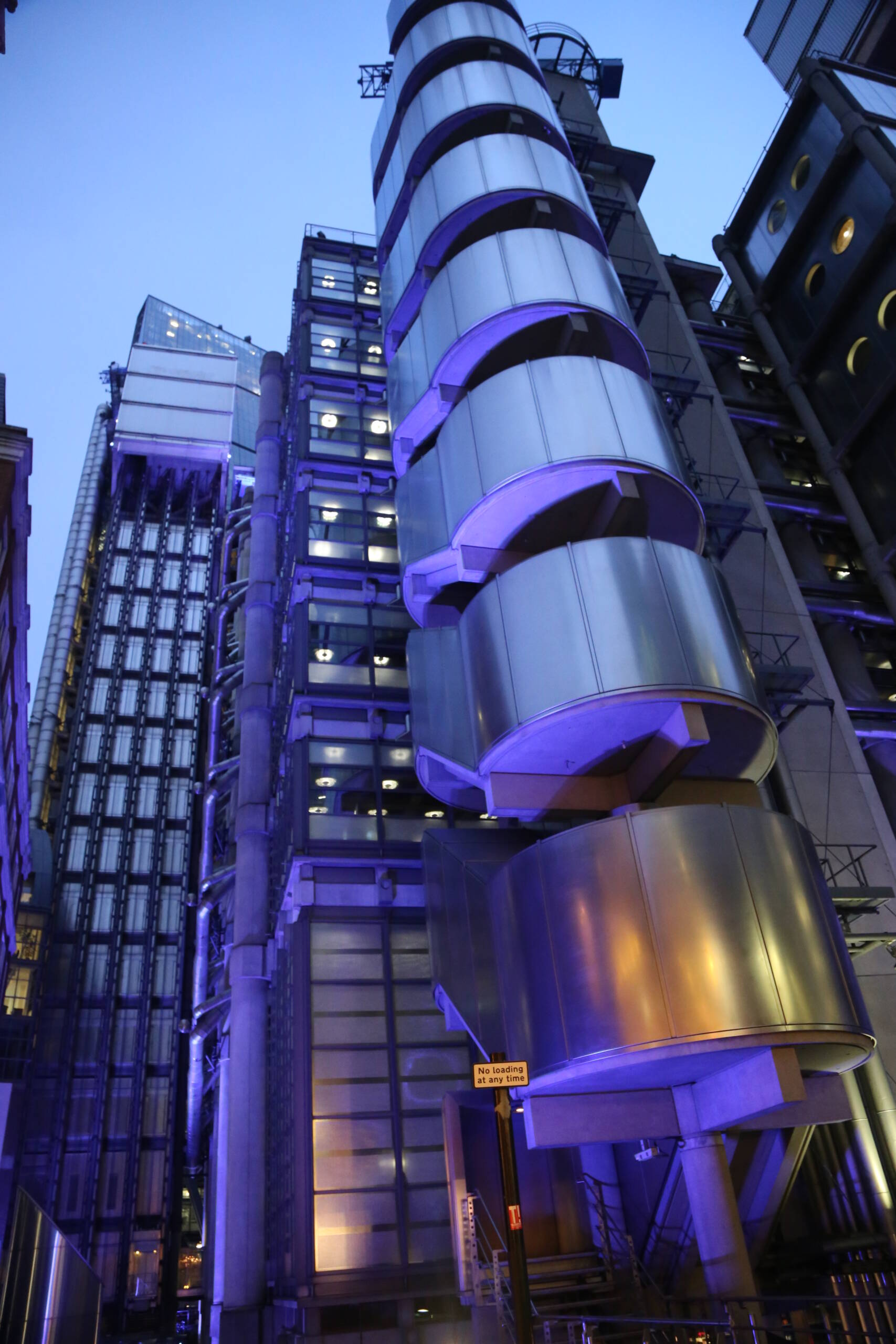
The insult and the idea were the same thing. Rogers put the servants of the building on the outside: staircases, lavatories, ductwork, water pipes, and twelve of the fourteen lifts, along with the maintenance cranes that live permanently on the roof. Arup engineered it, with Peter Rice leading. What that buys you is an interior with nothing fixed in it. The underwriting room sits under a barrel-vaulted glass roof at the top of a sixty-metre atrium, and the galleries around it can be added to or given up as the market swells and contracts. Plumbing gets repaired from a cradle outside rather than by ripping open a ceiling above a trading floor.
Nobody had built a headquarters that way before. The premise was that a building is a machine that will be wrong within a decade, so the only sensible design is one that can be corrected without stopping work.
The purple wash that everyone photographs now was not part of it. That came in 1988, a lighting scheme by Imagination, two years after the doors opened. The most recognisable thing about the building is an afterthought.
The Older Rooms Inside the Machine
Rogers kept the past on the premises, which is the detail people miss. The arched Leadenhall Street portal from Cooper’s demolished building survives as an entrance, a 1925 façade glued to a 1986 machine. Inside, on the eleventh floor, sits the Adam Room, an eighteenth-century dining room by Robert Adam that Lloyd’s had bought out of Bowood House in Wiltshire decades earlier and moved in whole. Committee meetings happen in it. Somewhere below, the Lutine Bell hangs, salvaged from a frigate lost in 1799 and rung to stop the room when news arrived.
So the address holds three centuries at once, stacked without apology. A Georgian dining room, a Jazz Age doorway, a shipwreck’s bell, and a steel exoskeleton, all in daily use by an insurance market that traces itself to a coffee house.
Then the State Froze It
On 19 December 2011 Historic England listed the building at Grade I. It was twenty-five years old, the youngest structure ever to receive the highest grade of protection in England. The citation called it universally recognised as one of the key buildings of the modern epoch, and praised, among other things, its flexibility of plan.
Read that twice. The building was protected in part for its capacity to be altered, and the protection makes altering it very difficult. Grade I listing controls what can be touched, and here the thing worth preserving is a machine whose entire argument was that machines should be adjustable. A design that treated permanence as a design flaw is now permanent by law.
Rogers, for what it is worth, spent his career arguing that buildings should be replaceable and that cities die when they are embalmed. He died in 2021 with his second major work legally embalmed.
Lloyd’s does not own it any more. Ping An bought the freehold in 2013 for a reported two hundred and sixty million pounds, and the market rents its own icon. There have been long conversations since about whether Lloyd’s stays past the lease at all, which raises a question the listing cannot answer. A building shaped entirely around one institution’s way of doing business, and forbidden from changing much, becomes an awkward proposition the moment that institution leaves.
Forty years on, the oil rig won the argument and lost the ability to make it again.