Bilbao's Overcast Light Is the Right Light for the Ensanche's Neo-Gothic Churches
I still don’t know which church this is. I walked past it, looked up, took the picture, and kept going, and by the time I thought to check I was three streets away and it had started to rain. There are a lot of these in Bilbao. Grey stone, gold trim round the windows, a spire that goes up further than it needs to, wedged in between an office block and a bank branch like nobody planned any of it.
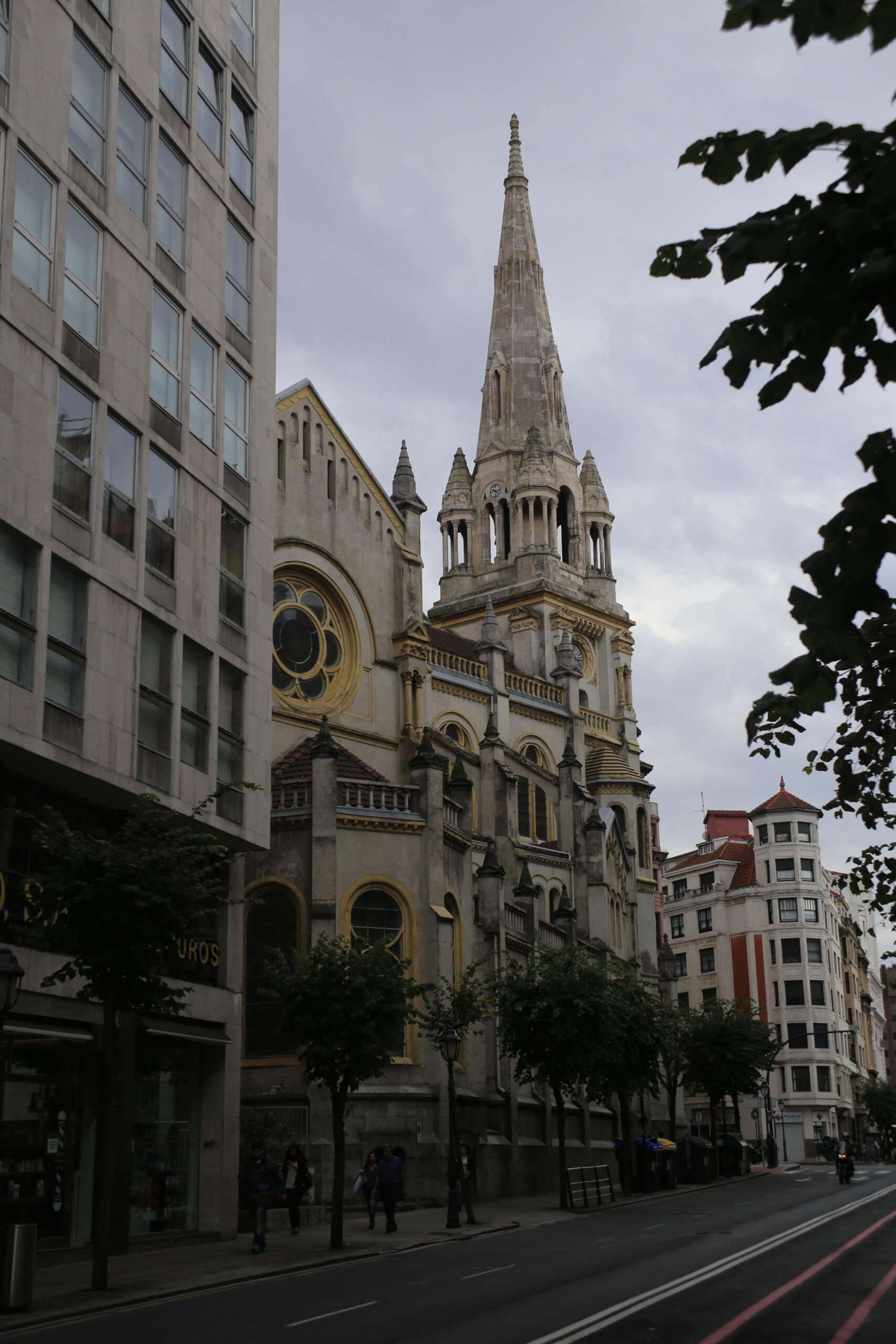
Nobody did plan it, not together anyway. The Ensanche is the grid they laid out west of the old town in the late 1800s, when iron ore money was pouring in off the Nervión and Bilbao suddenly had a middle class that wanted somewhere to live. Wide streets, bay windows, a boulevard down the middle. The churches went up at the same time as the apartment blocks, for the same congregation, in a Gothic style that was already four hundred years dead. Everyone knew it was pastiche. That was the point. New money likes to look old.
The sky does the work
It rains here. Not dramatically, mostly. There is a word for the local drizzle, sirimiri, the kind that hangs in the air rather than falling, and it soaks you slowly while you insist it isn’t really raining.
That weather is why this photograph works and a sunny one wouldn’t.
Bright light flattens limestone. It bleaches out the carving and turns every recess into a black hole, and you end up with a postcard of a church instead of a picture of one. Cloud does the opposite. Soft even light gets into the crockets and the pinnacles and the little arcaded lantern under the spire, and the stone goes the colour it actually is, which is a hundred years of soot and rain and not much scrubbing. The gold paint round the rose window stops looking gaudy and starts looking tired, which is better.
The trees along the pavement went almost black in the frame. I left them there.
A city that got rebranded and kept the bones
You know the story. Bilbao was a heavy industry town, the shipyards and the furnaces closed, the river was filthy, and then in 1997 a titanium building landed by the water and the whole place became a case study in urban regeneration that every mid-sized post-industrial city has been citing at council meetings ever since.
All true. Also not the interesting part.
The interesting part is the two hundred metres of street in this photo, which the Guggenheim story skips over entirely. A speculative office slab on the left with windows like a spreadsheet. A church built to impress shipping families who have been dead for a century. Behind it, the white miradores with their red roofs, glassed-in balconies stuck on the front of every building because if you live somewhere this wet you build a room to sit in and watch it. Three completely different ideas about what a street is for, all touching.
Nobody in the shot is looking up. Four or five people on the pavement, heads down, going somewhere. That is what a working city looks like.
If you go
Skip the museum for a morning. Walk the Ensanche grid instead, Gran Vía and then off it, north and south, and let yourself get slightly lost among the banks and the insurance offices. The good stuff is at roof level and nobody is competing with you for it.
Go when it’s grey. It usually is.
I’ll find out what the church is called eventually. I’m in no hurry.