Vermeer's Thirty-Six Rooms
Johannes Vermeer lived 43 years, fathered fifteen children, worked as an art dealer to support them, and left behind approximately 36 paintings. The number is not certain — attribution disputes move a few canvases in and out — but the range has never extended far past 40 in either direction. For a professional painter of the Dutch Golden Age, this is an almost implausibly small body of work. His contemporary Jan Steen produced over 800 paintings. Rembrandt made somewhere between 300 and 400. Vermeer, in a career that lasted roughly 20 years, produced what amounts to fewer than two paintings per year.
The restraint — if it was restraint, and not circumstance, or slowness, or some combination the historical record cannot untangle — is part of what makes him extraordinary. Each of the 36 contains the impression that it cost everything.
He worked in Delft his entire adult life. He was born there in 1632, probably the son of a silk weaver who later became an innkeeper and then an art dealer; Johannes inherited both the inn and the dealing business and ran them alongside the painting. He was received into the Delft painters’ guild in 1653 and became its dean, or presiding officer, twice — a position that implies professional respect, if not commercial success. He died in 1675, deeply in debt. His wife Catharina, left with eleven surviving children and no income, declared bankruptcy within months.
The paintings that produced his posthumous reputation were sold off to cover the debts. They scattered across Dutch collections for two centuries, attributed variously to Gabriel Metsu, Pieter de Hooch, and others, before the French critic Théophile Thoré-Bürger systematically gathered them back under Vermeer’s name in a series of articles published in 1866. The reconstruction of the œuvre is itself a kind of detective story, and not a finished one: the 1945 discovery that Han van Meegeren had been forging Vermeers and selling them to Hermann Göring, among others, demonstrated how precarious the attribution question remained even after two centuries of scholarship.
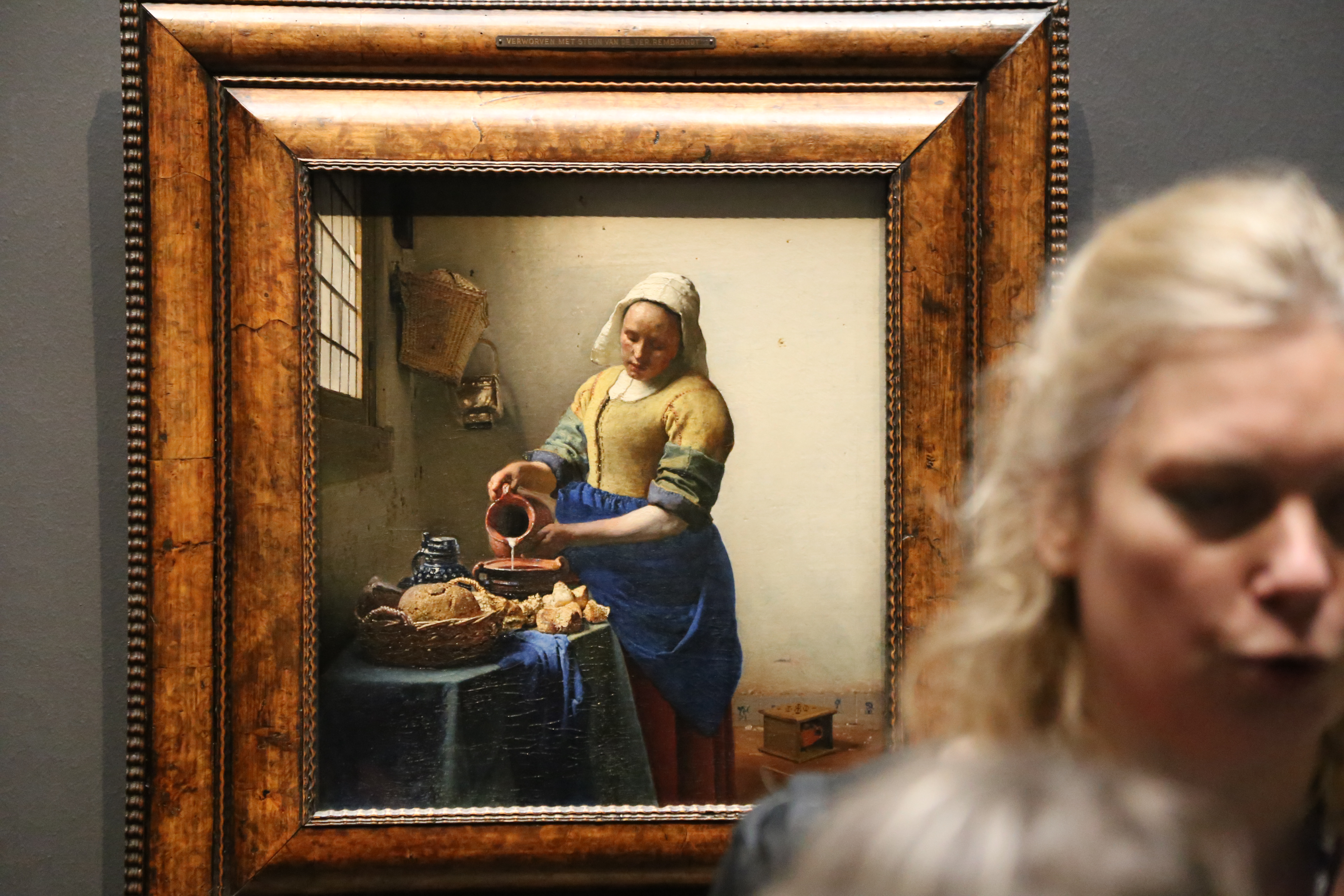
The paintings Thoré-Bürger reassembled share a recurring world: the corner of a room, light entering from a window on the left, a woman alone or with one other person engaged in an activity that is mundane and — in Vermeer’s treatment — somehow total. A woman reading a letter. A woman pouring milk. A woman weighing pearls. A woman at a virginal. A woman with a pearl earring, which is not a domestic scene but a portrait, and which has become the most recognized painting in the world after the Mona Lisa, which is a fact that would have been completely incomprehensible to Vermeer.
What Vermeer did with light is not simply a technical achievement, though the technique is extraordinary: the gradations of illumination across a white wall, the way linen catches a window’s glow, the quality of shadow on a map — these are rendered with a precision that led, in the twentieth century, to the serious proposal that he used a camera obscura to achieve them, projecting the scene onto the canvas as an optical guide. The proposal remains contested. Whether he used it or not, the effect is not mechanical. The light in Vermeer’s interiors is not the light of documentation. It is the light of attention — the quality of illumination that only appears when someone has looked at a thing long enough to see what it actually is.
The subject of most of the 36 paintings is the interior life of ordinary women going about their days in rooms that are modest, clean, and suffused with afternoon. The women are not performing for the viewer. They are absorbed in what they are doing. The letter they are reading is private. The milk they are pouring is going where milk goes. Vermeer does not explain their inner states or dramatize their situations. He simply records the quality of presence — the way a person looks when they are fully inside a moment they did not know would be preserved.
He left almost no documentary record. No letters, no diary, no statements about his methods or intentions. Two letters exist, written by others, that mention him briefly. The View of Delft (c. 1660-1661), his only surviving landscape, shows the city from across the river — its towers and rooftops reflected in still water, a cloud shadow crossing a section of the wall — with the same quality of suspension that characterizes the interior scenes. Nothing is happening. Everything is exactly as it is.
Proust wrote, in In Search of Lost Time, that a character encounters a small patch of yellow wall in the View of Delft — “a little patch of yellow wall” — and dies of the shock of its beauty, of the recognition that he had wasted his life producing literature that would never achieve what that patch of paint achieves. Whether Proust himself had the same response to the actual painting, or whether he invented the episode as a literary device, he identified something real: the quality in Vermeer that resists all description while demanding it.
Thirty-six rooms. Fifteen children. A life spent in debt in a city he never left. The paintings arrived in the right century, barely, and found their audience.
He did not know they would.