Spain’s National Day 2026: A Ceremony of Continuity, a Government Nearing Its End?
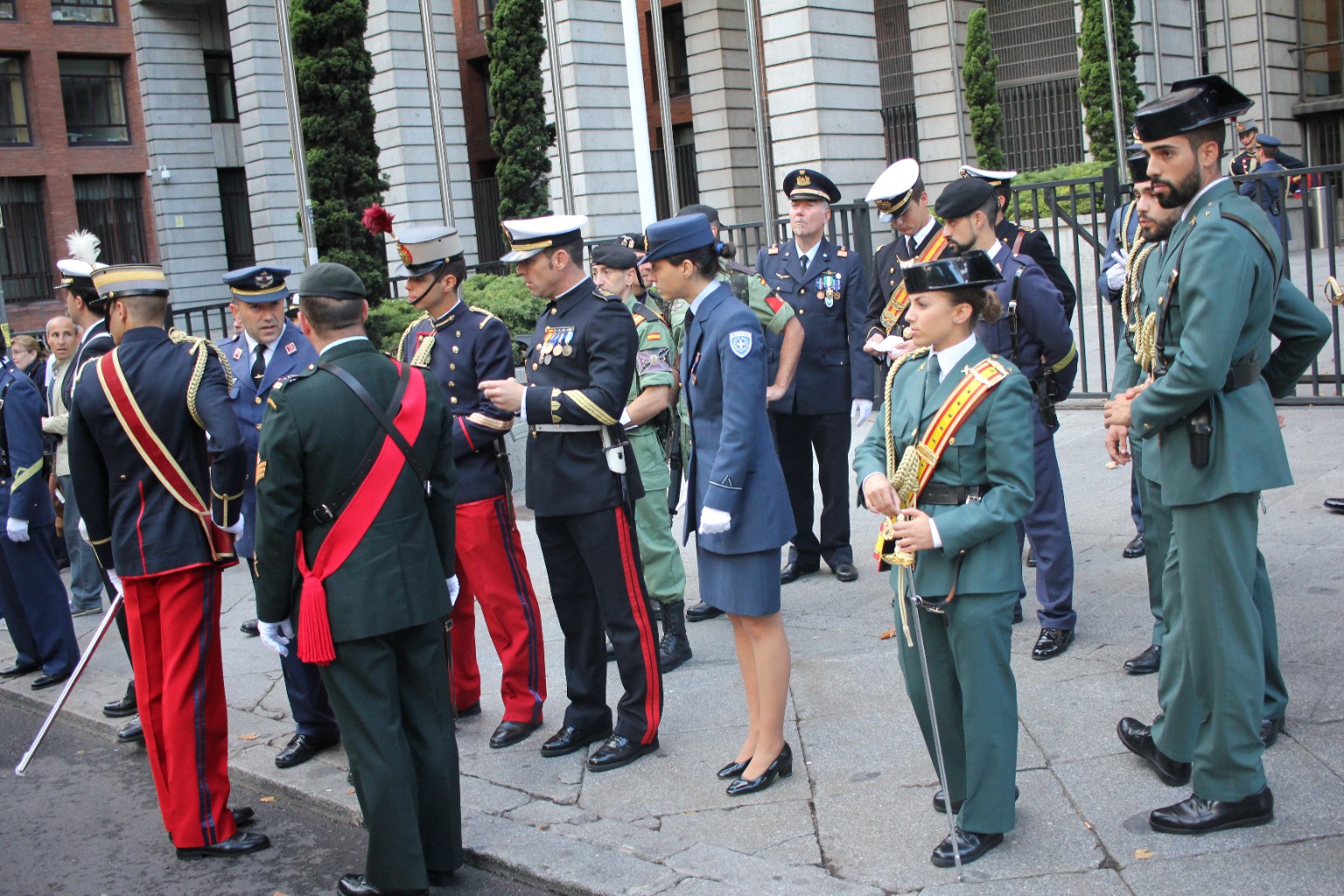
Photographed by the author on Spain’s National Day. Image hosted by MediaGallery.org.
The photograph captures something particularly Spanish: an extraordinary variety of military uniforms, ceremonial swords, decorations, polished boots and elaborate headgear gathered in one rather ordinary urban setting. Officers in dark blue and red stand alongside members of the Guardia Civil in green, naval personnel in white caps and representatives of other uniformed services. Some are talking, others adjusting their uniforms or waiting for instructions. A female officer stands prominently in the foreground with a ceremonial sword, while a tall Guardia Civil officer to the right wears traditional black headgear. There is a wonderful contrast between the solemnity of the uniforms and the casual, slightly untidy human activity before a ceremony begins.
Spain celebrated its National Day on October 12, 2026, with the familiar symbolism of national unity, military tradition and constitutional continuity. Yet this year’s celebration took place against a political background considerably less reassuring for Prime Minister Pedro Sánchez. His government has survived through parliamentary arithmetic, negotiations with regional parties and an impressive ability to endure crises that might have brought down less resourceful administrations. Survival, however, is not the same as political strength.
There is a reasonable possibility that this was the last National Day celebrated under the Sánchez government. That is a political prediction, not an established outcome. Spain’s next regular general election is expected in 2027, and the prime minister has repeatedly demonstrated that predictions of his imminent departure can be premature. Still, the cumulative burden of political controversy, fragile parliamentary support and public frustration makes the prospect of a change of government plausible.
And good riddance, if that is how it turns out. Sánchez’s critics see his administration as an example of political survival becoming an objective in itself, with concessions to parliamentary allies and tactical maneuvering taking precedence over coherent national leadership. His supporters would counter that he has maintained a progressive governing coalition in a deeply fragmented political system. Both interpretations deserve recognition, but neither changes the fundamental question: whether the government still possesses sufficient parliamentary capacity to govern effectively rather than merely remain in office.
The photograph offers a useful counterpoint to political uncertainty. Governments come and go, parliamentary coalitions form and collapse, and prime ministers eventually leave office. The uniforms, ceremonies and institutions remain. That is one of the essential functions of a national holiday: to remind citizens that the country is larger and more enduring than whichever politicians happen to govern it. Spain will celebrate October 12 again in 2027. Whether Pedro Sánchez will still be prime minister is another matter entirely.