Bandinelli's Hercules and Cacus: It Looks Like a Forced Sexual Act Prelude
Stand under Baccio Bandinelli’s Hercules and Cacus in Piazza della Signoria and look up. Hercules has a fistful of Cacus’s hair. Cacus is down on one knee, face tipped upward, parked right at Hercules’s hip with his mouth half open. From below, the two heads and Hercules’s genitals stack into a single vertical line. My first thought wasn’t triumph. It looked like the moment before a forced sex act.
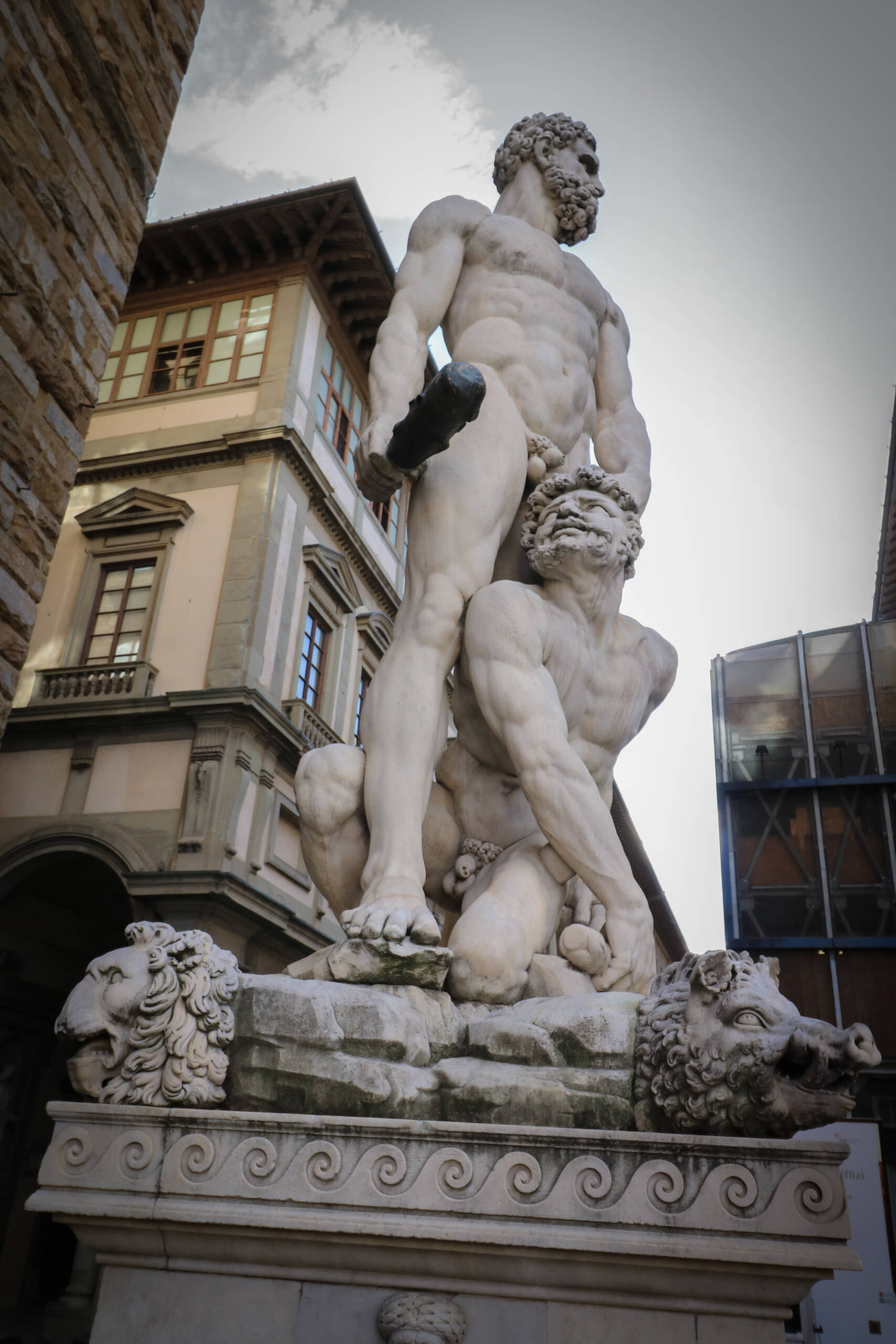
I don’t think that’s a dirty mind at work. The statue was built to humiliate someone, in a city that had very specific ideas about what humiliation between two men looked like.
Florence Knew What This Pose Meant
The group went up in 1534, outside the palace doors, as a partner for Michelangelo’s David. The timing matters. Four years earlier the Florentine republic had fallen after a long siege; the Medici were back, and Alessandro de’ Medici had been made duke. Hercules had been on the city’s seal since the Middle Ages. Cacus, the thief who stole his cattle and hid them in a cave, was easy to read as whoever had opposed the family. The message to the square was blunt: we won, you kneel.
Compare it with the David a few steps away. The republic’s hero stands alone. Bandinelli’s hero needs a man underneath him.
Now think about who was looking at it. Renaissance Florence had such a reputation for sex between men that Germans used “Florenzer” as slang for a sodomite. The city ran a special magistracy, the Office of the Night, to police it for seventy years, and many thousands of men passed through its records. Florentines drew a hard line inside that world. The man who took the dominant role kept his standing. The one who submitted was the one disgraced.
So picture a grown man forced to his knees, head pulled back by the hair, face level with the victor’s groin. For a Florentine in 1534 that was about the most shaming position one man could put another in. If you wanted to show a beaten enemy utterly unmanned, that was the vocabulary lying around. Bandinelli used it, whether he’d have admitted it or not.
The Gossip Never Stayed Clean
The statue was a joke before it was finished. The marble block, originally earmarked for Michelangelo, fell into the Arno on its way to Florence, and people said it had tried to drown itself rather than be carved by Bandinelli. When the group was unveiled, Florentines covered it with mocking verses. Duke Alessandro had some of the authors thrown in prison.
Years later, in front of Duke Cosimo I, Benvenuto Cellini tore into it. He said the torso looked like a sack of melons propped against a wall. Bandinelli didn’t defend his anatomy. He shouted back that Cellini was a sodomite, in open court. Cellini put the whole exchange in his autobiography (and in 1557 he was in fact convicted of sodomy). Sex was the insult both men reached for, standing next to this exact commission.
Then go upstairs. In the Salone dei Cinquecento, inside the same palace, Bandinelli’s pupil Vincenzo de’ Rossi carved a series of Hercules labours. In one of them, Hercules and Diomedes, the upside-down Diomedes grabs Hercules by the genitals mid-fight. Florence’s Hercules kept ending up in these positions.
What I Can’t Claim
Nothing in the records says Bandinelli meant any of this sexually. The complaints we have are about bad anatomy and vanity; nobody at the time called the group obscene. Kneeling captives were also standard kit for victory sculpture. Michelangelo’s Genius of Victory, in that same hall upstairs, has a young victor pinning an old man with his knee, and nobody reads that one as foreplay.
And my camera did some of the work. At eye level from the square, the heads and the groin drift apart and it reads more like a conventional triumph. Shoot it from below, the way I did, and the alignment snaps shut.
But you can’t un-see it once it’s there.