The Fencer of Wroclaw: A 1904 Fountain That Outlived the City That Commissioned It
On 26 November 1904 a naked young man with a sword went up on a small square in front of the university’s main building in Breslau, and the city has been telling stories about him ever since. He is still there. The buildings behind him are the same yellow Baroque wing, the square has the same awkward triangular shape, and the water still comes out of the four faces on the rim of the bowl. Almost everything else about the place has changed, including the language people use to talk about him.
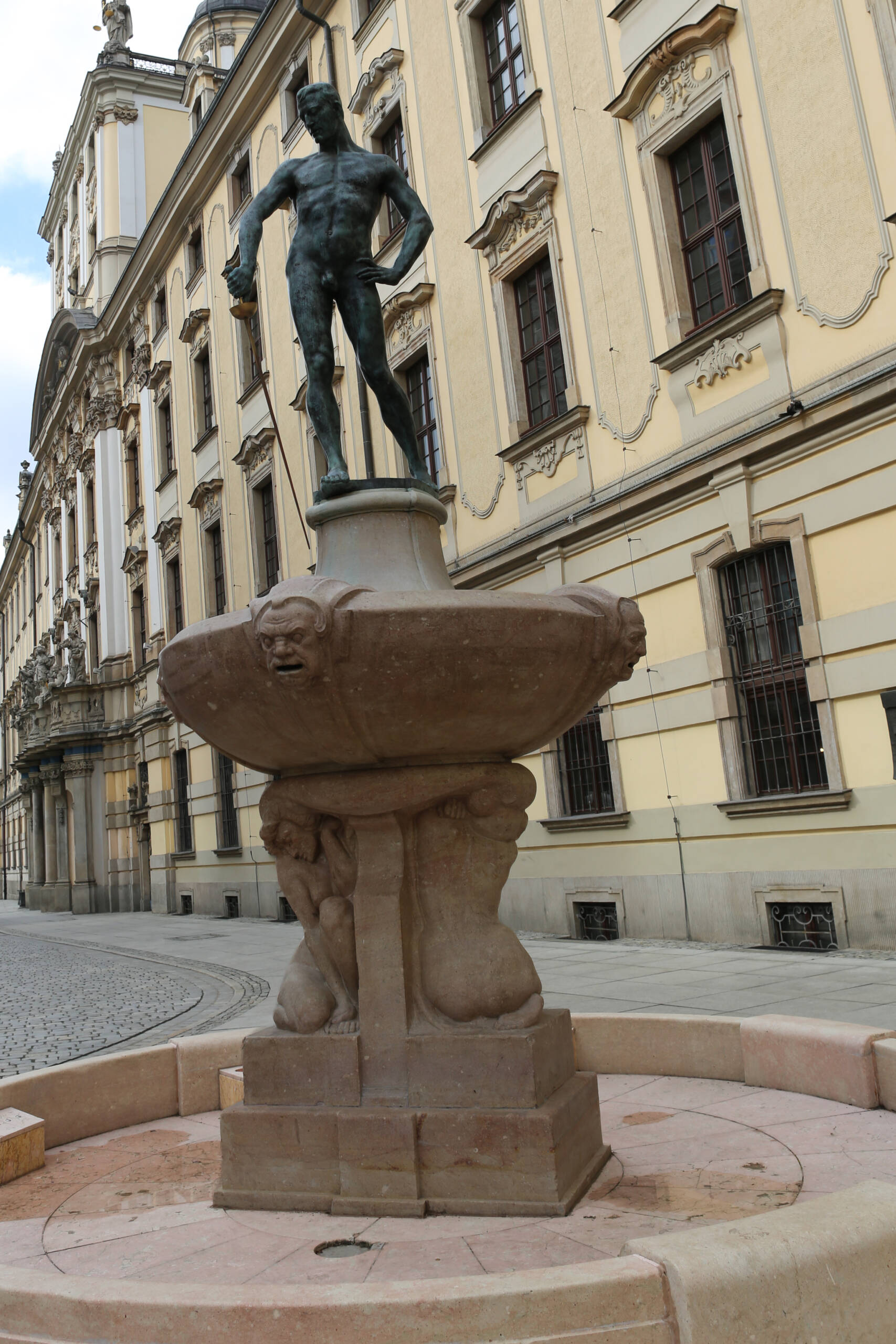
The figure is worth looking at before the legends crowd it out. He stands in an easy contrapposto, weight on one leg, left hand on his hip, the curved blade held low in his right. There’s no armour, no fencing jacket, no mask. He is a classical nude holding a sabre, which is a strange combination if you think about it for more than a second. Beneath him two seated female figures hold up the sandstone bowl, and four grotesque heads spit water into the basin. Local tradition insists the heads are caricatures of professors. Nobody has ever proved it, and nobody in Wroclaw seems to want it proved either way.
The sculptor was Hugo Lederer, then a professor at the Berlin Academy of Fine Arts, who had trained in Breslau under Christian Behrens. Two years later he’d finish the enormous Bismarck monument in Hamburg, the granite colossus that made his name. The fencer is the lighter work, but the anatomy is obsessive. Conservators who worked on the restoration a few years ago pointed out that the veins on the hands are modelled, individually, in bronze.
The Student Who Lost Everything But His Sword
The story everyone tells goes like this. A wealthy young student arrives in the city. Older students take him out. They drink, then they play cards, and the stakes climb through the evening until he has gambled away his money, his property and finally his clothes. All he has left is the blade. That’s the man on the pedestal.
There’s a second version, more scandalous and much better as gossip, in which the ruined student is Lederer himself and the fountain is his confession, installed at municipal expense in the middle of the university district as a warning to everyone who comes after him. Art historians have been quietly dismantling this for a century. The likeliest explanation is dull. Lederer hired a model, a tall good-looking young man, and paid him by the sitting.
The legend survives anyway, because it does something the sober version can’t. It explains the nudity. A city that puts an unclothed youth in front of its most respectable building needs a story, and a cautionary tale about drink and cards is a very convenient one.
A German Monument With a Polish Afterlife
What the fencer meant in 1904 is not what he means now, and the gap between the two is the interesting part.
Breslau was a German university town with a duelling culture. Student corps fought the Mensur with sharpened blades, and the facial scar was a mark of belonging rather than an accident. A sword on a fountain outside the main building read, in that setting, as a compliment to a particular kind of student masculinity, dressed up in classical marble-and-bronze language to make it respectable.
Then the city ended. The siege of 1945 flattened much of Breslau, the German population left or was expelled, Poles arrived from the east, and the new administration went through the streets removing German inscriptions and German monuments with real enthusiasm. A German professor’s bronze in front of the university was an obvious candidate for removal.
He stayed. Polish students adopted him, gave him the name Szermierz, and made him theirs. They dress him during Juwenalia. They stole his sword so many times as a dare that replacing it became a routine municipal expense. He’s a good luck charm now, and a meeting point, and the thing you photograph first.
The bronze never changed. Everything around it did.