Most Medieval Stained Glass in Flemish Churches Was Made in the 1800s
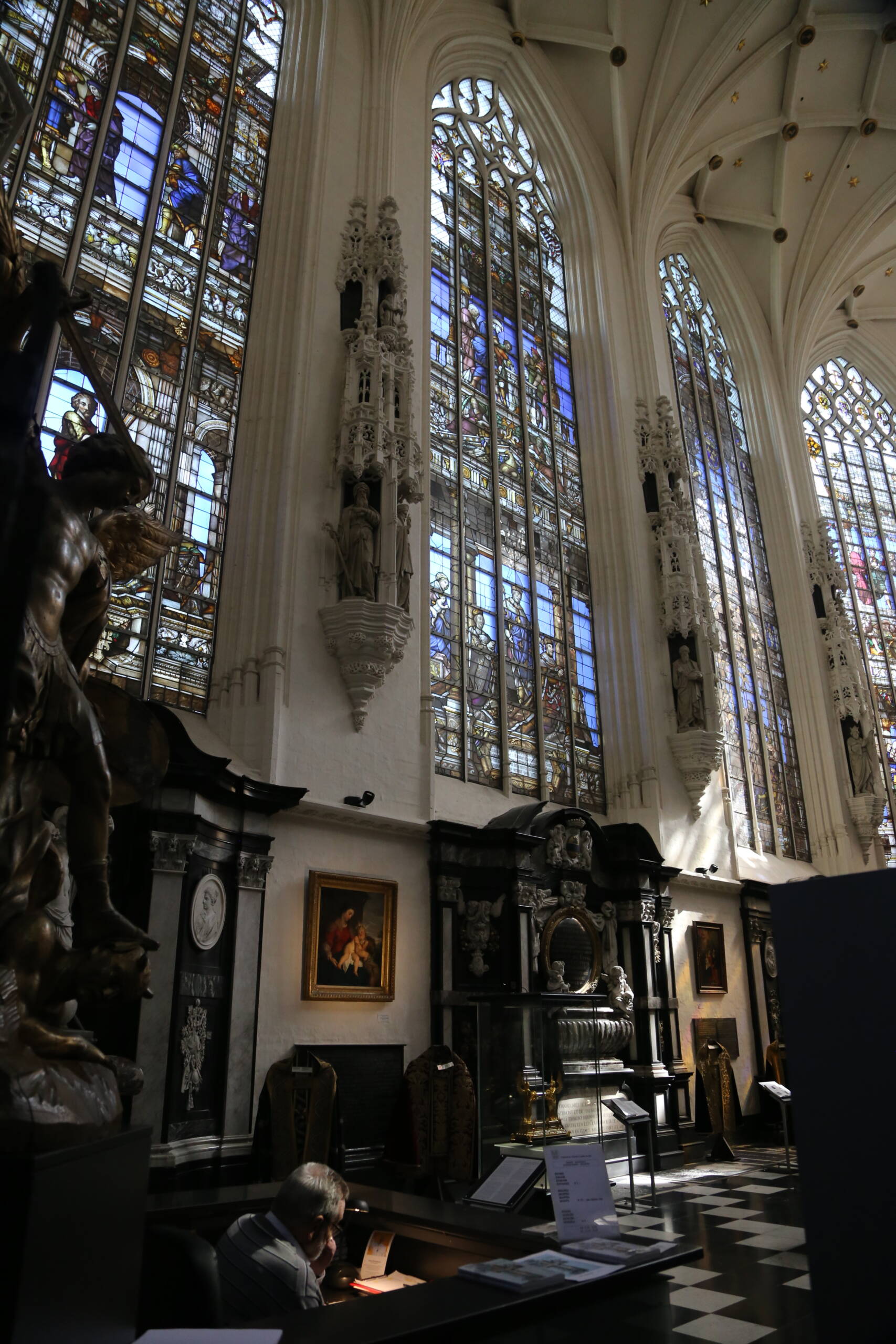
Stand in the nave of almost any large Flemish church and look up at the tall windows. Saints in blue and gold, donors kneeling at the bottom, borders of painted foliage, everything glowing the way you were told medieval glass is supposed to glow. Then check the date. In a lot of cases it is somewhere between 1840 and 1900, and the building around it is the only genuinely old thing in your field of view.
This is not a scandal, and nobody is hiding it. It is just that visitors arrive with an assumption, and the assumption is wrong.
What actually happened to the old glass
Medieval windows in the Low Countries had a bad four hundred years. The iconoclastic fury of the 1560s went after images wherever it could reach them, and glass is easy to reach. Fires took more. Antwerp’s cathedral burned in 1533 and was still being patched a century later. Storms, structural work, and the ordinary sag of lead cames finished off plenty of what survived. Then the French revolutionary period arrived, churches were deconsecrated and stripped, and whatever was left was lucky rather than protected.
What survives from before 1600 is thin. Antwerp Cathedral still has Nicolas Rombouts’s Last Supper window from 1503, and it is worth finding precisely because it has so little company. Brussels kept a run of sixteenth-century windows in the Chapel of the Holy Sacrament at Sint-Goedele, and even those were heavily worked over later.
So the nineteenth century inherited enormous Gothic buildings with clear glass, cheap replacement panes, or gaps. It filled them.
The revival was an industry, not a rediscovery
The man whose name you will run into most often is Jean-Baptiste Capronnier. His father came out of the Sèvres porcelain works, set up a Brussels workshop in the late 1820s, and Capronnier took it over in 1839. He built his reputation first on restoration and on copying old panels for the archaeological museum, which is the important detail. He learned the medieval craft by taking it apart. In 1854 he was at Chartres drawing thirteenth-century borders by hand.
Then he sold that knowledge at scale. Windows for churches in Brussels, Bruges, Ghent, Amsterdam, England, France, Italy. A medal at the Paris exhibition of 1855, another in London in 1862. This was a supplier with a catalogue and a workforce, not a lone craftsman recovering a lost secret.
The timing was not accidental either. Belgium became a country in 1830 and immediately needed a past to point at. Gothic was the style of the Burgundian and Flemish golden age, which made it useful. Filling the national monuments with new glass in the old manner was cultural policy carried out one lancet at a time.
Why it matters when you are looking at it
Once you know the century, the windows read differently and mostly read better.
Nineteenth-century glass is more transparent and more evenly coloured than medieval glass because the industrial furnaces were more consistent. Figures have modelled faces, correct anatomy, and receding architectural backgrounds, because the designers went to art academies and had absorbed Renaissance painting. Medieval glaziers were assembling coloured shapes bound in lead; the revivalists were painting pictures on a translucent support. Both are impressive. They are not the same thing.
The other tell is the donor panel at the bottom, and the signature. Capronnier signed and dated his work. Look at the bottom corners before you assume anything.
The second and third rounds
Nineteenth-century glass then got its own turn at destruction. Blast damage in both world wars took out windows across Belgium and northern France, and a fair amount of what stands today is a mid-twentieth-century replacement of a nineteenth-century replacement of a lost medieval original. In Antwerp and Leuven especially, a single window opening can represent three separate campaigns of glazing across four hundred years.
The building is medieval. The light coming through it has been remade at least twice, by people who wanted you to think it never changed. That is the more interesting story anyway.