The Rubens House Studio in 2014, a Room Now Shut Until 2030
I took this on 8 May 2014, at about twenty to two in the afternoon. It is the large studio in the Rubens House in Antwerp, the room where Rubens and his assistants turned out the enormous canvases that went to Madrid and Paris and London. I had a very wide lens on the camera that day, which is why the ceiling looks like it belongs to a cathedral. It doesn’t. It is a tall room in a merchant’s house, and the wide angle flatters it.
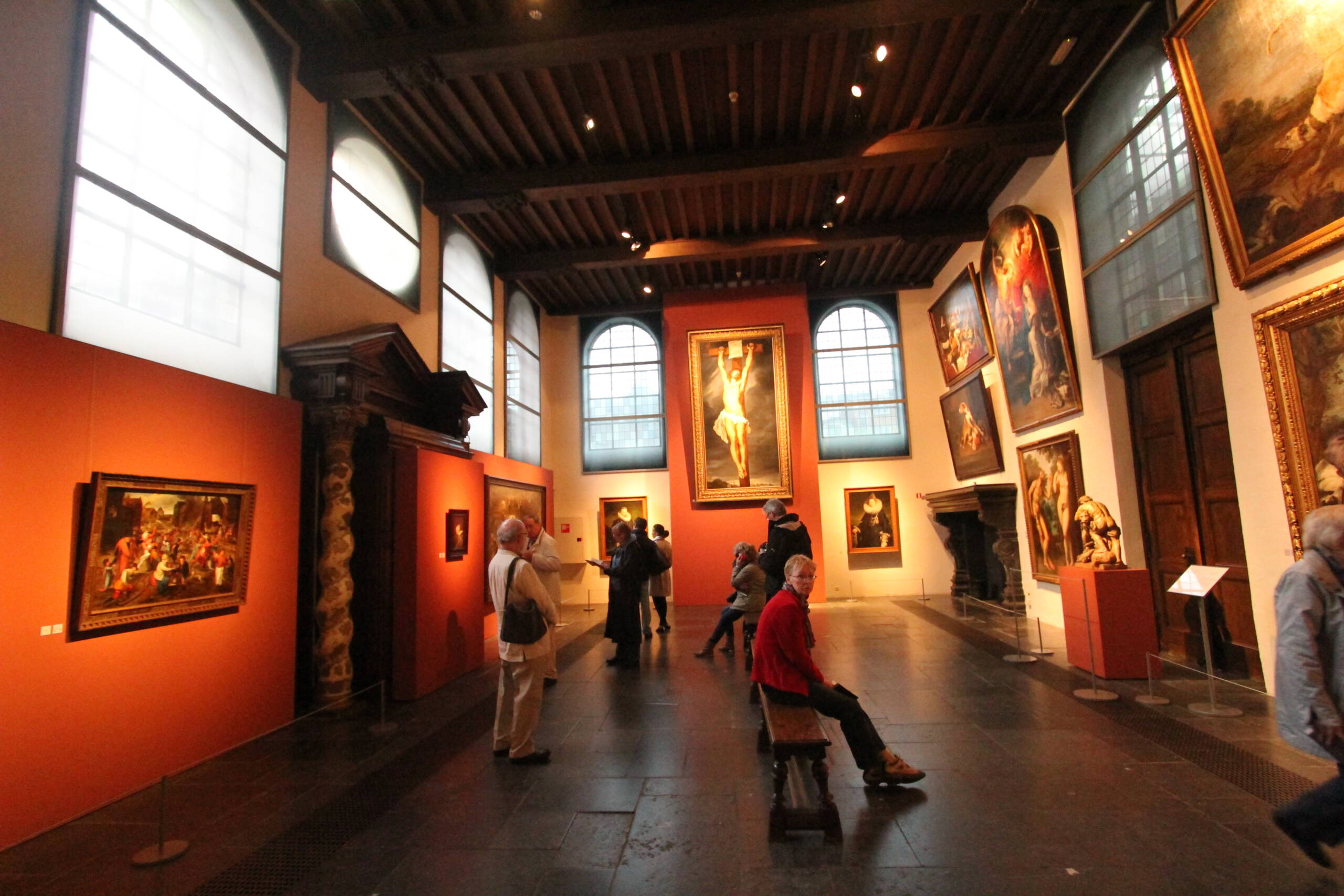
What I did not know at the time was that I was photographing a temporary arrangement. Not the building, which has stood since Rubens bought the plot in 1610 and has been a museum since 1946. The hang. The particular way the pictures were placed on the walls that afternoon.
Look at what the curators were doing. A block of terracotta red set against the pale plaster, with a Crucifixion centred on it, hung exactly between the two arched windows so the daylight frames it. Freestanding red panels marching down the left side of the room, carrying a village scene in a heavy gold frame. On the right, canvases stacked three deep in the old salon manner, with a sculpture on a low red plinth beneath them. Somebody thought hard about all of that. Somebody argued about the colour of the red.
The house closed and did not come back
The Rubens House shut its doors on 9 January 2023 for restoration. That was supposed to be a four-year job with the reopening timed to 2027, the 450th anniversary of Rubens’s birth. It has since become a much longer one. The artist’s residence is now not expected to open again before 2030. The wider transformation has been running since 2016, which will make it a fourteen-year project by the time anyone walks back into that studio.
The museum has not gone dark. A new entrance building on Hopland opened in the summer of 2024, and it gives you the library, the rebuilt Baroque garden, and a multimedia room called the Rubens Experience. Visitors have opinions about paying full price for a house museum with no house. But the studio, the bedrooms, the kitchen, the semicircular sculpture gallery, all of that is behind hoarding.
The hang will not survive the restoration
Here is the part that makes an ordinary tourist snapshot worth keeping. In January 2026 the museum appointed the design teams for the restoration and, separately, for the new scenography. Scenography is the museum word for how the collection meets the visitor. Wall colours, sightlines, plinths, what hangs next to what, where you are made to stand and where you are made to walk.
A new scenography means the arrangement in this photograph is finished. The red panels, the tiered stack on the right wall, the Crucifixion placed between those two windows. Whatever opens in 2030 will be the product of a different set of arguments, made by different people, under a climate control system that did not exist in 2014 and which will itself dictate a lot about where a painting can safely go.
So the room in the picture is gone twice over. Once because you cannot enter it, and again because even when you can, it will look like something else.
I am not making a complaint about the renovation. Museums in seventeenth-century buildings have a genuinely hard problem, and this one has been trying to solve it since 2016. A house designed to be lived in by a wealthy family has to hold paintings at stable humidity, take a lift, take a fire system, take crowds, and stay a house.
But it is a good argument for photographing rooms you think are permanent. Buildings get documented. Collections get catalogued. The specific choice of hanging a Crucifixion off-centre in a strip of terracotta red, on a Thursday in May, tends not to get recorded by anyone except the people wandering through with a camera and no particular plan.
Mine was frame 5239.