Gauguin's Arearea: The Red Dog Paris Mocked in 1893 and the Painting He Bought Back
The guide in the purple cardigan has a microphone curled against her cheek, and the young man in the grey hoodie has a receiver tucked in his ear. Between them hangs a painting that could have used her in 1893. When Paul Gauguin’s Arearea first went on show in Paris, it carried a Tahitian title almost nobody in the gallery could read. No one stood beside it to explain.
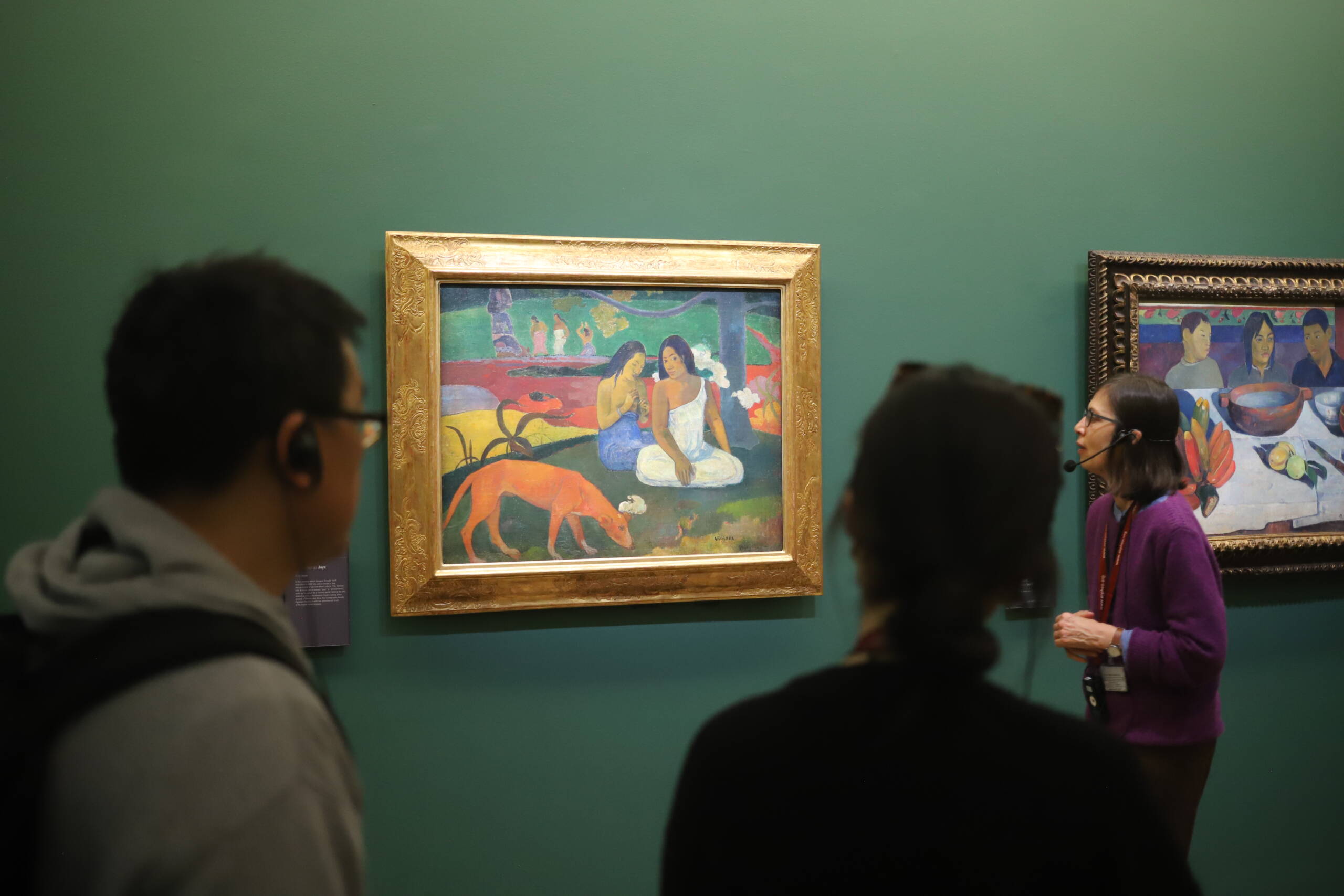
Gauguin painted it in 1892, about a year after he sailed for Tahiti looking for a way of life he thought Europe had lost. Two women sit on the grass at the center. One plays a small flute; the other faces out at us, legs folded under a white dress. A tree trunk slices the canvas from top to bottom. Behind them, tiny figures bow before an idol, a ceremony Gauguin simply made up (he took a small carved figure and scaled it up until it loomed like a temple Buddha). There’s no sky at all. Where it ought to be, he laid down flat slabs of color, stacked like folded cloth.
Then there’s the dog. Orange going on red, head down, nose in the grass, it walks across the foreground as if the picture belongs to it.
Paris Laughed at the Dog
The November 1893 exhibition at Durand-Ruel’s gallery was supposed to prove the trip had been worth it. Gauguin hung his Tahitian canvases for a city that had half forgotten him. It went badly. Plenty of his friends were put off by the Tahitian titles, and the red dog drew the sneers, the easy target for anyone who wanted one.
What Gauguin did next is the part worth remembering. He rated Arearea among the best things he’d ever painted, and the laughter didn’t move him an inch. In 1895, before he left Europe for good, he bought it back for himself.
Think about that for a second. An artist spending his own money to rescue the picture everyone mocked.
The Polynesia in it was always partly his own invention, an old-fashioned, idealized place laid over what he actually saw on the island. The rite in the background is made up. So, in a gentler way, is the calm.
The Explaining Came Later
The painting took the long way to this green wall. It was bequeathed to the French state in 1961 and sat in the Louvre’s collection until 1986, when it crossed the river to the Musée d’Orsay. Next to it hangs The Meal, from 1891: three Tahitian children behind a table of bananas and a wooden bowl, painted in his first months there.
Now Arearea gets everything it lacked in 1893. A wall label. A guide with a headset, talking. A small group on receivers, standing still and listening, which is more patience than Paris gave it the first time.
The dog is still red.