The Met's Du Val d'Ognes Portrait Changed Artists Twice and Lost Value When It Stopped Being a David
A man in a black jacket stands in front of it with his hands in his pockets. A woman walks past without looking. This happens all day, every day, in the French rooms on the second floor of the Met, and almost nobody stopping there knows they are looking at the most argued-over label in the building.
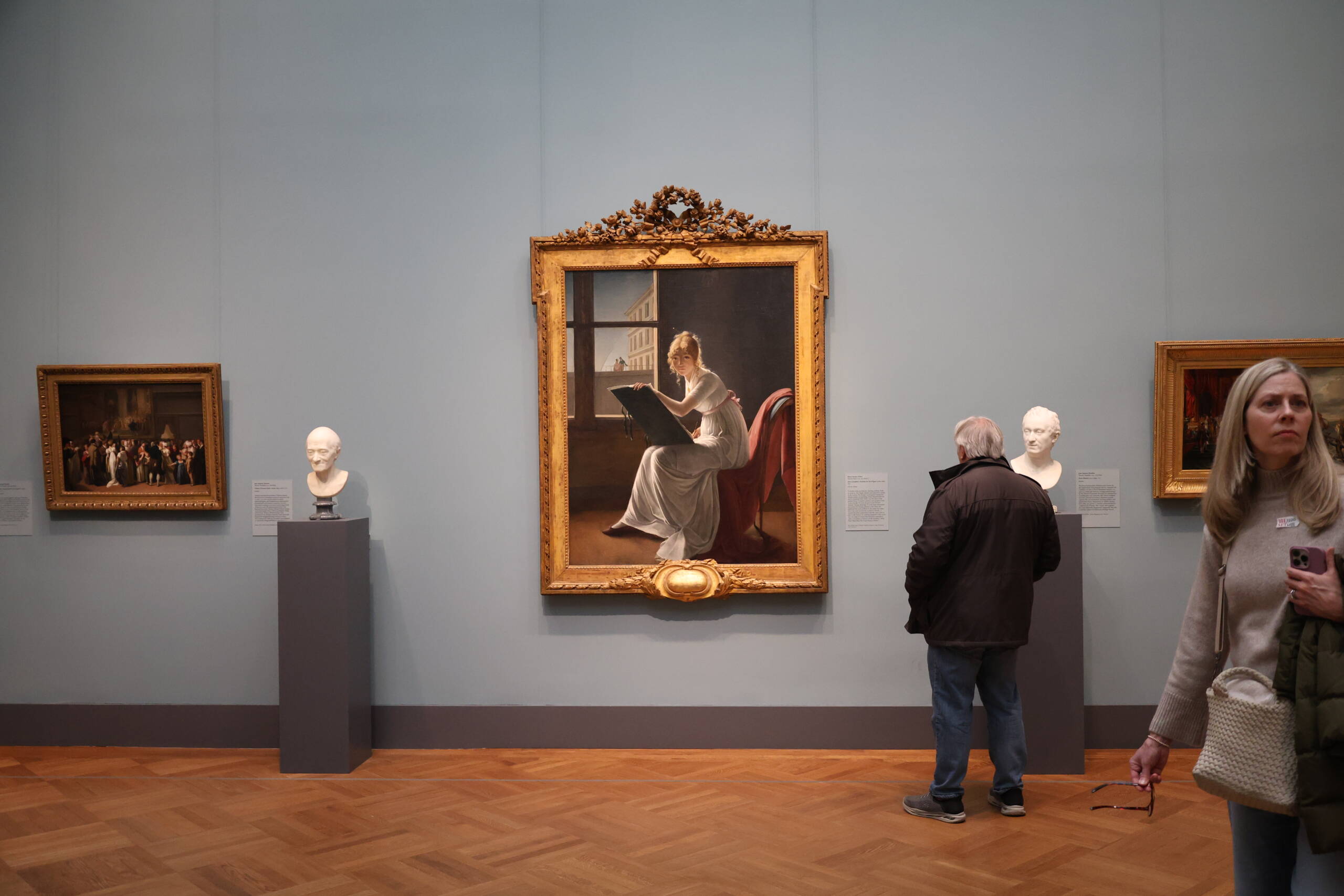
The picture itself is calm enough. A young woman sits with a drawing board on her knees, in the white tunic every fashionable woman in Paris was wearing in 1801, red drapery bunched on a chair behind her. She has turned to look straight out of the canvas. Whoever she is looking at, that person is the one she is drawing. Which means the painter is standing exactly where you are standing.
Then the strange parts start piling up. The window behind her has a cracked pane, painted with obvious relish, and no art historian in two centuries has produced a convincing reason for it. Through the glass, two tiny figures lean their heads together on a parapet. She is alone and absorbed. They are not.
Four artists, one canvas, no signature
Nobody signed it. That is the root of the whole mess.
The du Val d’Ognes family owned it for generations and believed it was a Jacques-Louis David. The Met bought that story along with the painting in 1917, hung it as a David, and left it there for decades. Then in 1951 Charles Sterling, the curator preparing the museum’s French catalogues, pointed out an inconvenience: David did not exhibit at the Salon of 1801. He reassigned the picture to Constance Marie Charpentier, a student of David’s. In 1996 Margaret Oppenheimer found a smaller preparatory version by Marie-Denise Villers and moved it again. Villers is what the wall label says now, and Villers is what most people accept, though “attributed to” is doing quiet work in that sentence.
In 2011 Anne Higonnet suggested the sitter and the painter might be the same person. A self-portrait, made with a mirror, which would explain the eye contact rather neatly.
The really embarrassing bit
Here is what makes the story worth telling rather than just filing.
The paint did not change. Not one square centimetre of it. But the way critics described the same canvas flipped the moment the presumed painter stopped being a man. As a David it had been admired for its severity, its unflattering honesty, its rigour. As soon as it was a woman’s work, the writing about it filled up with charm and delicacy and, inevitably, faults. Sterling’s own commentary is the specimen everyone quotes, and it did not age gracefully.
The market agreed. A canvas worth a fortune as a David was worth considerably less as a Charpentier. Same brushstrokes. Different name on the card.
Go stand where the painter stood
If you find yourself in gallery 614 or thereabouts, the marble busts on grey plinths flanking it, do the one thing the picture is asking for. Stand square in front of it, close enough that her gaze locks on. She is drawing you. She has been drawing whoever stands there since 1801, under three different names, at wildly different valuations, with a cracked window nobody can explain and a couple in the distance nobody can identify.
She looks entirely untroubled by any of it.