Historical Reenactment Shows and the Desire to Watch the Past Come Alive
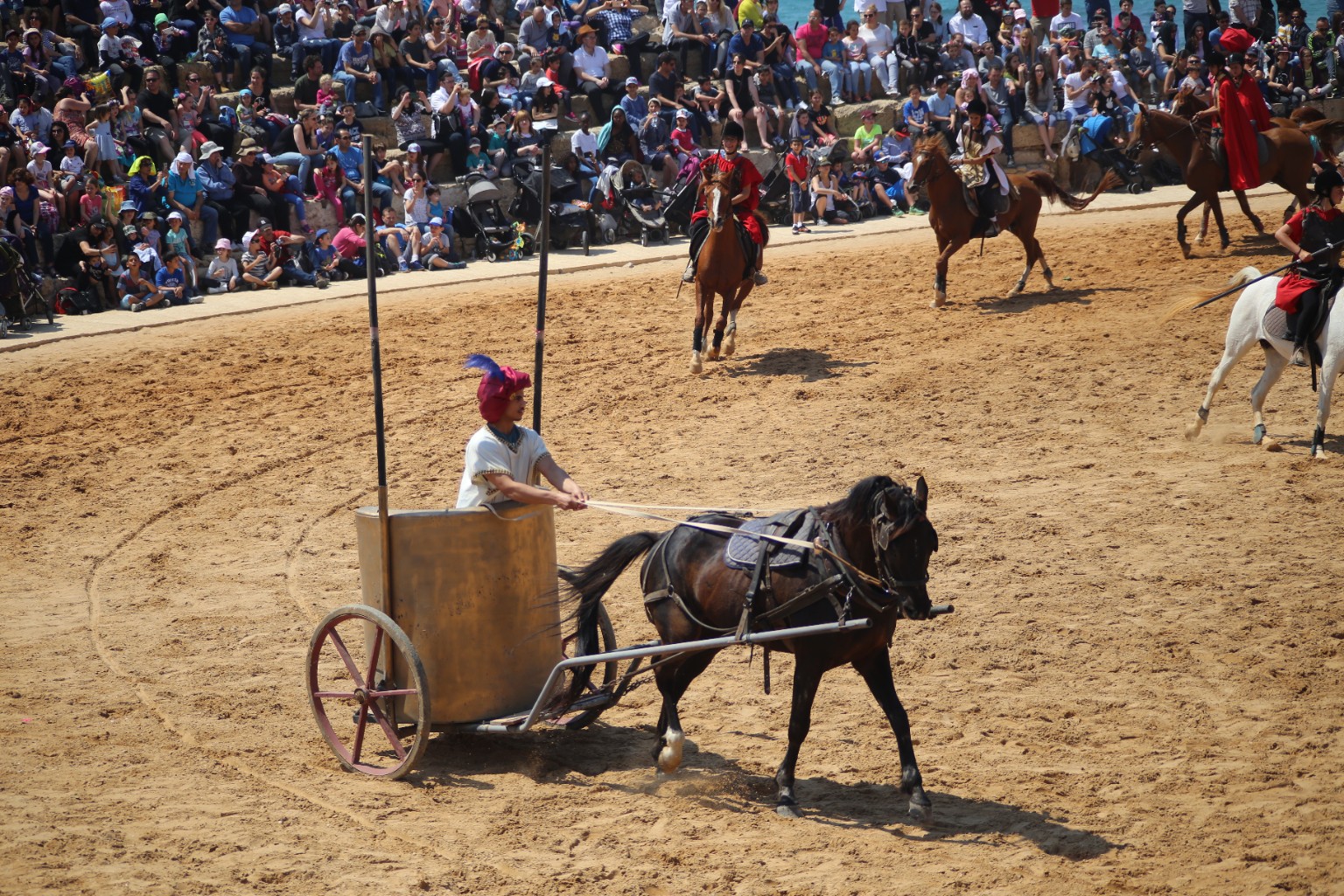
The horse has already crossed the part of the arena where the spectators were looking a moment ago. Its forelegs lift through the bright sand, the harness draws tight, and the wooden chariot follows on two narrow wheels. Behind it stands a performer holding the reins, dressed in a pale tunic and a magenta head covering with a blue plume. For a few seconds, the distance between a familiar historical image and a moving object becomes surprisingly small. A chariot is suddenly something that jolts, turns and needs somebody capable of controlling it.
The photograph holds several kinds of time together. In the foreground, a dark horse pulls a curved, ochre-coloured chariot whose reddish wheel spokes stand out against the ground. Two tall poles rise above the driver’s compartment. Farther back, a rider in red approaches on a chestnut horse, while another in cream and gold crosses the arena to the right. A red cape hangs almost to the flank of a horse near the upper corner; at the edge of the frame, a white horse and a rider carrying a long pole are partly cut off. Beyond this carefully arranged world sits an entirely modern crowd: sunglasses, baseball caps, pushchairs, cameras, children leaning forward. Hoofprints and wheel tracks overlap across the sand. The photograph does not establish the venue or the production’s intended historical setting, but it captures the essential bargain of the historical show. Everyone can see that this is a performance. They have come because a performance can make certain things visible.
Photograph hosted by MediaGallery.org.
Historical reenactment begins with a problem that every museum knows. Most surviving objects have been separated from the actions that gave them meaning. A saddle rests on a support. A sword lies behind glass. A garment is displayed on a body that never sweats or bends. Labels can explain their use, sometimes very well, yet movement supplies information that a label struggles to carry. Watch a rider adjust a rein before turning and the horse stops being background scenery. Watch the chariot follow a wider curve and the vehicle becomes a practical arrangement of balance, traction and judgement. You need not believe you have travelled into antiquity to learn something from that encounter.
Several different activities are gathered under the word reenactment, and the distinctions matter. A reconstruction of a particular battle attempts to represent a recorded event, with named sides and an outcome that the audience may already know. Living history more often presents ordinary work: preparing food, repairing equipment, making cloth, tending a camp. A historical arena show may borrow from both while building its programme around horsemanship, stage combat, music and a fictional story. The costumes may suggest a period without belonging to one narrowly defined place and year. Each form can offer a worthwhile experience, though each makes a different promise about its relationship to evidence.
The Battle of Hastings offers a useful example of how the modern performance acquires a history of its own. The first regular modern reenactment was staged in 1966 for the battle’s nine-hundredth anniversary. English Heritage’s account of restored footage from that event describes a production whose success helped establish an annual tradition. The old film also reveals how much staging and safety practice have changed. There are now two pasts to look at: the medieval conflict being represented and the twentieth-century people deciding how to represent it. Costumes, choreography and the audience’s expectations all leave their own historical record.
That second layer is easy to overlook because spectacle feels immediate. A horse moving across sand is real; so is the rider’s effort. The clothing around that effort may be a careful reconstruction, a convenient stage adaptation or a mixture. An impressive stunt establishes the performer’s skill. It cannot, by itself, establish that people in the period performed the same manoeuvre, wore that combination of garments or used that particular vehicle. Historical accuracy has to be assessed detail by detail. The more persuasive the show becomes, the more useful it is to keep that small distinction in mind.
There is also a difference between discovering what reconstructed equipment allows and proving what happened centuries ago. Trying a technique can expose a practical difficulty that a drawing conceals. A strap slips; a garment restricts an arm; a wheel behaves badly on a particular surface. Such observations can generate good questions for historians and archaeologists. Their value depends on how the reconstruction was made, what assumptions went into it and whether the conditions resemble those being studied. The applause at the end of a demonstration settles none of those questions. It was never designed to.
Living history can widen the picture beyond the dramatic encounter in the arena. English Heritage describes a reenactment community that includes cooks, servants, merchants and farmers alongside soldiers and jousters. These quieter roles change the scale of attention. Someone has to feed the people who appear in the battle scene. Someone has to maintain their clothes, transport supplies and care for their animals. A cooking demonstration may explain social rank through the contents of a pot; a repair can reveal the hours of labour concealed inside an apparently simple object. Sometimes the most instructive part of a historical event is taking place away from the largest crowd.
The audience in this photograph is part of the subject, too. Families occupy the stone seating in loose clusters, some watching the nearest rider, others talking or looking elsewhere. That uneven attention belongs to live performance. A child may remember the white horse rather than the story; an adult may notice the harness or the driver’s stance. The show offers a shared point of entry, and people take different things from it. This can be especially useful for history, which often reaches a visitor first as an image or a question and only later as sustained reading. The encounter does not have to deliver a complete lesson to open a door.
Its omissions still matter. Historical entertainment has strong reasons to favour bright clothing, recognisable heroes and a clean ending. The actual societies being evoked contained labour, coercion, illness and inequalities that are harder to fit into an afternoon programme. Martial display can make power look attractive while leaving the people subjected to it outside the frame. A thoughtful production can acknowledge this through its narration, programme notes or conversations with performers. It can also be candid about invented characters and uncertain details. A visitor deserves to know where the surviving evidence ends and the staging begins.
Modern safety and animal care belong within that judgement. Historical resemblance cannot be the only measure of a public performance involving horses, vehicles and an audience close to the action. Trained animals, controlled distances and adapted equipment can be necessary parts of presenting an event responsibly. The resulting show is a modern cultural activity with obligations to living participants. That is one reason an exact return to the past is an impossible standard, even before the gaps in the evidence are considered.
Look again at the chariot near the bottom of the photograph. The horse’s shadow stretches across the sand, sharply outlined in the sun. The driver holds the reins with both hands, concentrating on something the camera cannot quite tell us: the next turn, the horse’s pace, a cue from another performer. Behind him, the crowd remains visible in all its ordinary modern variety. The scene works because those two worlds can occupy the same frame. We know the past has not returned. Still, for the length of a circuit around the arena, there is something moving in front of us that a page alone could not show.