Wawel Hill in Kraków: The Castle, the Bronze Model, and the Churches Drawn on the Grass
Most heritage sites ask you to look at one moment. Wawel makes you look at four or five at once, and it does this on a single lawn, in about the space of a football pitch.
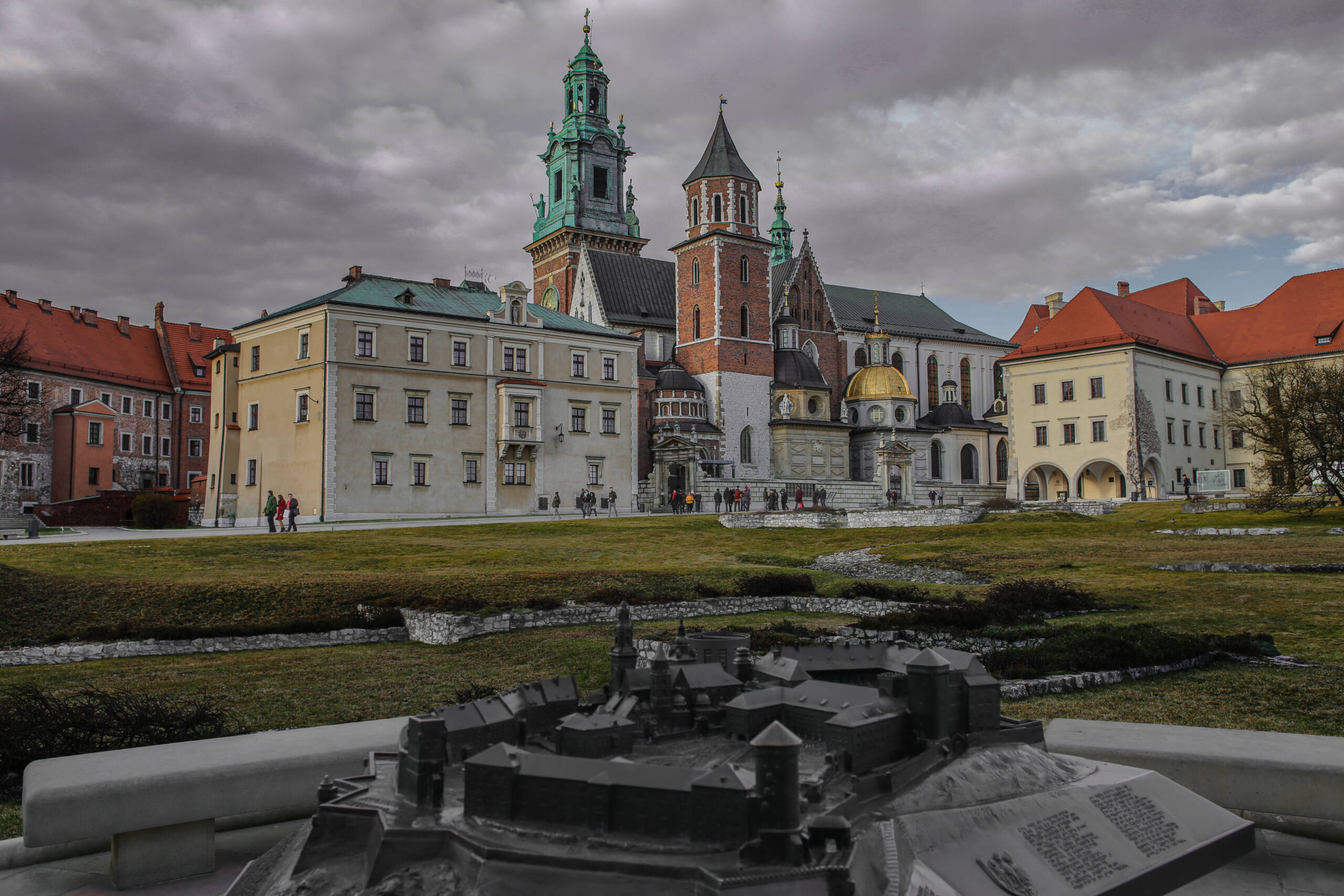
Stand at the south-eastern end of the outer courtyard and the hill lays itself out like a diagram. In the middle distance, the cathedral: a green copper cap on the Sigismund Tower, a brick clock tower with the flag on it, and off to the right the gilded dome of the Sigismund Chapel, which has been catching whatever light Kraków can spare since the 1530s. Around it, a wall of buildings that mostly aren’t royal at all. The long cream block with the regular window grid is barracks architecture, put up when the Austrians held the hill and treated it as a fortress rather than a coronation site. The red roofs on either side belong to that same military century. The castle proper, the arcaded Renaissance courtyard that turns up on every postcard, is hidden behind them.
Then there is the grass, which is the strange part.
Those pale stone lines running through the turf are not landscaping. They are the footprints of buildings that were taken down in the first years of the nineteenth century, when the hill was converted for garrison use and two medieval churches, St Michael’s and St George’s, were pulled apart for the space they occupied. Nobody rebuilt them. Instead, at some point in the modern conservation era, someone made the decision to draw their outlines back onto the ground in stone, at full size, in the exact position. You can walk through a nave that hasn’t existed for two centuries. There is no roof, no wall, no elevation of any kind. There is a line, and the line is enough to tell you that something stood here and something took it away.
It is a peculiar kind of monument. It doesn’t commemorate the churches so much as their absence, and it makes the absence measurable. Twenty paces long. That wide. Right there, between the cathedral and the wall.
The model in the foreground
At the near edge of the courtyard sits a bronze relief model of the hill on a stone plinth, with a raised inscription panel beside it. These models are now standard at big European sites, and they exist first for visitors who can’t see the view, which is a good enough reason on its own. But they do something else too, and Wawel’s does it more sharply than most.
The model doesn’t show what’s in front of you. It shows Wawel as a walled medieval complex, packed tight inside its defences, with towers and gatehouses and a dense little town of buildings on top of the rock. Half of what’s cast in that bronze is gone from the real hill behind it. The Austrians cleared much of it. Some of it burned. Some was demolished in the nineteenth-century project of turning a royal seat into a barracks, and then again in the twentieth-century project of turning a barracks back into a royal seat.
So the foreground is a reconstruction of a Wawel that no longer stands, the background is a Wawel assembled from four centuries of building and unbuilding, and the ground between them is marked with the plans of churches that were removed to make one into the other. You can take all of that in without moving your feet.
What the hill is actually for
Kraków is unusual in Central Europe for what didn’t happen to it. It came through 1945 largely intact, which means its layers are original rather than restored from photographs, as they are in Warsaw or Gdańsk. That gives Wawel a particular authority. When the hill shows you a seam between periods, the seam is real.
And the seams are everywhere once you start looking. Romanesque foundations sit under the cathedral floor, in a basement exhibition assembled out of what excavation found. Gothic brick meets Renaissance stone at the cathedral’s outer wall without any attempt to blend them. Baroque chapels bulge out of the sides like additions to a house. The barracks windows march along in Habsburg rows, and above them the Polish flag flies from the clock tower, which is not an accident of flag policy.
A site like this resists the tidy single-date label that heritage signage prefers. Founded in the eleventh century, rebuilt in the fourteenth, remodelled in the sixteenth, occupied in the nineteenth, recovered in the twentieth. Every one of those is true and none of them is the answer.
The best thing Wawel does is refuse to choose. It keeps the barracks. It keeps the gilding. It keeps the outline of what was destroyed, drawn on the lawn in white stone, where the tour groups walk over it on the way to the cathedral door without always noticing what’s under their feet.