Why Lisbon Left the Carmo Convent Roofless
The arches at the top of the Carmo Convent carry nothing. They spring, they curve, they meet at the crown, and then there’s sky. Everything they were built to hold came down on 1 November 1755, and nobody put it back. Look closely at the roofline and you’ll see scaffolding tucked between the bays, which is the detail that gives the game away: somebody is paying to keep this building broken.
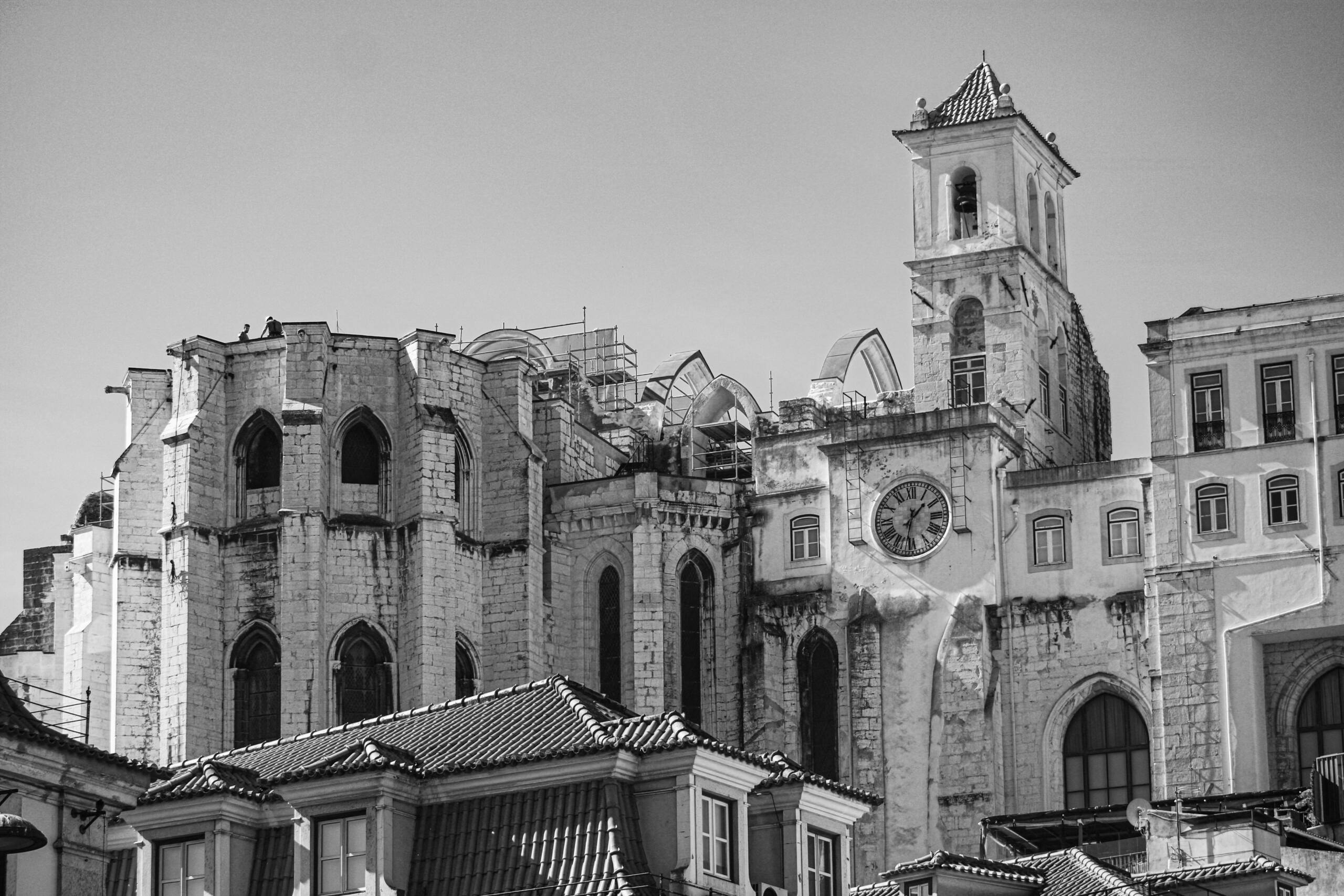
The convent was founded in 1389 by Nuno Álvares Pereira, the commander who had settled Portuguese independence at Aljubarrota four years earlier, and it went up between then and roughly 1423. For most of four centuries it was the grandest Gothic church in Lisbon, grander than the cathedral, and the Carmelites’ principal house in the country. The earthquake hit on All Saints’ Day, with the building full for morning mass, and the stone vault came down on the congregation. Fire took what the collapse left.
So far, so familiar. The interesting part is what came next, because the story everyone tells (Lisbon decided to keep its wound open) isn’t quite what happened.
The Ruin Nobody Decided On
Rebuilding started in 1756. There were plans, there were neo-Gothic elements, there was money spent. It just never finished. The work dragged through decades of political disorder, and in 1834 Portugal dissolved the religious orders, which removed both the owner and the reason. The shell was handed around for other uses: a barracks, a courthouse. A magnificent Gothic carcass sitting in the middle of Chiado, doing paperwork.
That’s not preservation, it’s abandonment with a roof missing. The deliberate part arrives thirty years later. In 1864 Joaquim Possidónio da Silva and the Association of Portuguese Archaeologists put a museum inside the ruin, Portugal’s first for archaeology and monumental art, and from that point the roofless nave stopped being a problem and became the exhibit. Giving the ruin a job is what saved it. Buildings with no use get quarried for stone.
Piranesi Got There First
By 1864, European eyes had been trained for a century to find exactly this beautiful, and that training is the reason the museum idea sounded like inspiration rather than neglect.
Piranesi had been etching the Roman vedute since 1748, and he cheated in a specific direction: he exaggerated scale, sank the ground, let weeds take the cornices, and put tiny ragged figures at the base of the columns so the stone would loom. Hubert Robert built a whole career on painted ruins in France, enough that people just called him Robert of the Ruins, and Diderot wrote about standing in front of those canvases and feeling time open up underneath him. In England, William Gilpin was explaining to tourists which valleys were composed correctly and which were merely pretty, and Uvedale Price was arguing about roughness and irregularity as values in themselves. Landowners were building fake ruined castles in their parks. Sanderson Miller made a small business of it.
Think about the timing. While English gentlemen were paying masons to construct broken walls on their hillsides, Lisbon had acquired a real one, at enormous cost, by accident. The men who founded the museum in the Carmo had grown up with prints of Piranesi’s Rome in circulation. They had the vocabulary ready.
Keeping a Ruin Is Hard Work
Here’s the contradiction the picturesque never had to face, because its ruins were either painted or freshly built. A preserved ruin needs constant repair to stay in its ruined state. Water gets into open masonry; frost widens the joints; unloaded arches behave in ways their builders never calculated for, since the weight they were designed to carry is the thing that kept them stable. Every generation has to decide how much decay is authentic and how much is just the next collapse arriving early. That scaffolding in the photograph is the answer to a question somebody had to ask.
Carmo also isn’t picturesque in Gilpin’s sense any more. The floor is swept, the fragments are labelled, there’s a ticket desk, and the arches frame a sky that the light-projection shows use as a screen on summer evenings. The vegetation that Piranesi loved has been removed, because vegetation is what destroys masonry. What you get instead is a very clean skeleton, curated decay, held at a fixed point in its decline.
The twentieth century took the same move and made it explicit. Coventry kept its bombed cathedral shell and built the new one beside it. Berlin kept the broken spire of the Kaiser Wilhelm church. Hiroshima kept the dome. All of them are arguments made in stone about what a society refuses to tidy away, and all of them descend from a habit of looking that was formed by eighteenth-century etchings of Rome. Albert Speer inverted it and proposed designing buildings for how well they’d ruin, which tells you the aesthetic can be pointed in unpleasant directions.
Photographed from below, in monochrome, none of the museum machinery shows. You get line against sky, the bays reading as pure drawing, and a clock tower next door still keeping time for a city that carried on. The ruin looks eternal. It’s maintained annually.