Villa Pacini and Catania's Headless Bourbon Kings
The king has kept his armour and lost his head. In a small garden in Catania, pale marble rises between the palms, its carefully carved breastplate still making the old claim to authority. A cloak falls from the shoulders; one hand remains raised; the legs hold their formal pose above a dark pedestal. Everything about the figure suggests that somebody expected it to command attention for a very long time. The empty space above the neck records what happened to that expectation.
The photograph catches the monument in a setting that almost disguises its violence. Broad leaves crowd the left side, rough palm trunks climb out of the frame, and feathered fronds spread behind the statue. Two smaller fan palms occupy the grass in front, where little yellow flowers interrupt the green. On the right, narrow leaves edge into the view. Farther back are railings, a bin and a person in blue, the unceremonious furniture of a living city. The marble looks still and exposed among all that growth. You notice the missing head a second before you begin wondering whose it was.
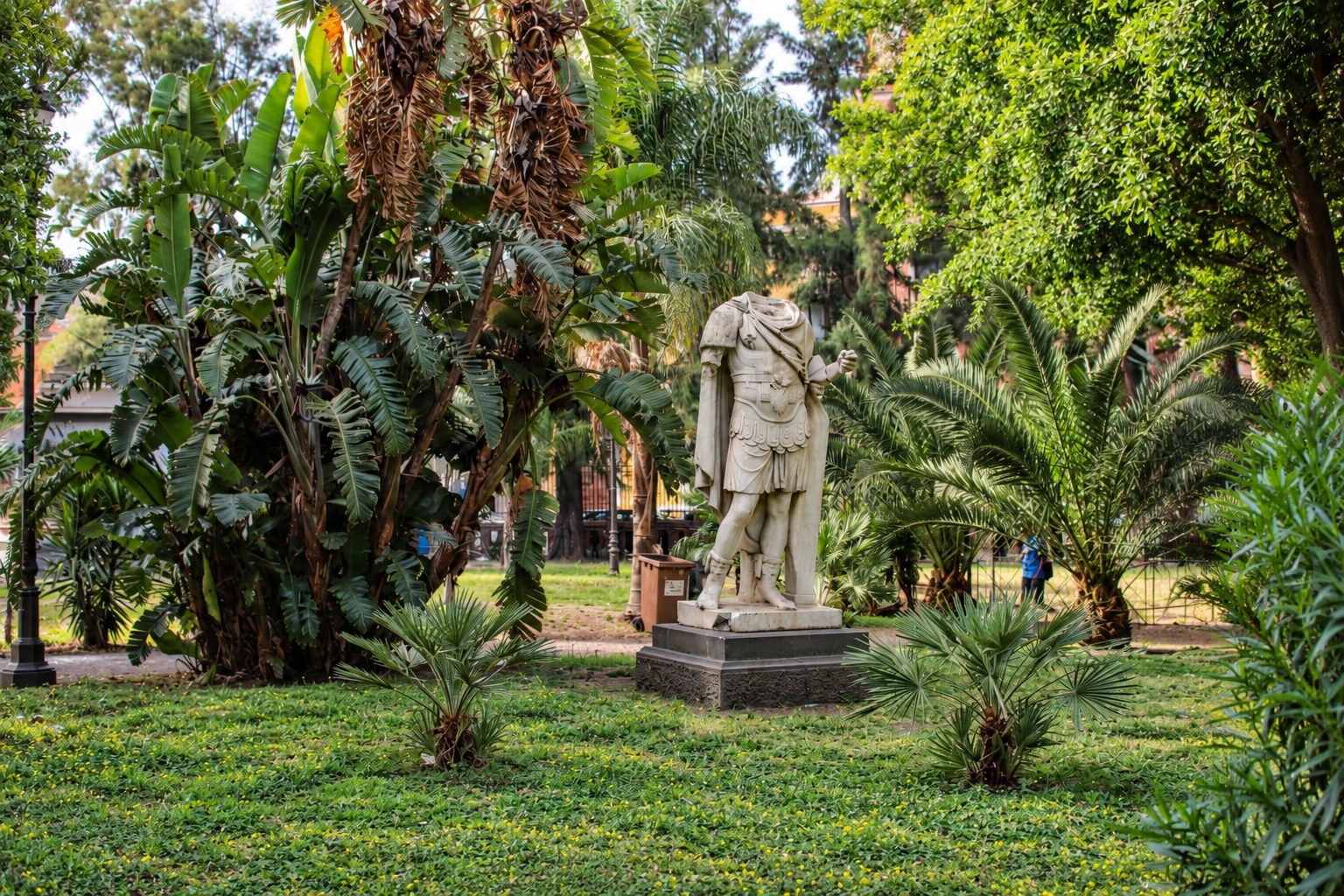
Photograph hosted by VirtualTravelGuide.com. Cropped and digitally enhanced from the original photograph.
This is Villa Pacini, also known as Giardino Pacini, near Porta Uzeda and Catania’s waterfront railway arches. Its damaged royal sculptures belong to the Bourbon monuments made for the city by Antonio Calì. The classical costume can send a visitor looking in the wrong century: these are nineteenth-century kings presented through the visual language of antiquity. Local accounts identify the two figures inside the garden as Francesco I and Ferdinando II. The photograph alone does not securely distinguish between them, so it is better to leave this particular king unnamed than attach the wrong biography to his pedestal.
Calì trained in the neoclassical world of Antonio Canova and Bertel Thorvaldsen. For royal patrons, the style offered a useful vocabulary: a ruler dressed in antique armour could borrow the dignity of an idealised ancient past. The sculpted cloak and breastplate made contemporary power appear to belong to a much longer tradition. The workmanship survives well enough to show how persuasive that promise was meant to be. Even without a face, the body continues its rehearsed performance of command.
The monuments began in more prominent places. Francesco I’s statue was erected in 1833 in the square associated with the university; Ferdinando II’s followed in Piazza Stesicoro in 1842. Another Calì monument, to Ferdinando I, was erected in 1853 and survives headless near Via Dusmet. Their later proximity can blur their separate histories. They were public statements made at different moments, for different rulers, before they became a small family of damaged survivors.
Catania belonged to the Bourbon Kingdom of the Two Sicilies. In nineteenth-century Sicily, opposition to royal government drew strength from demands for constitutional rule and island autonomy. These conflicts made a monarch’s public image vulnerable in a very literal way. A marble king was accessible when the king himself was elsewhere. His face could be attacked, his pose mocked, his claim to permanence broken in front of witnesses. The crowd did not need to believe that stone was alive to understand the political force of cutting off its head.
The chronology deserves some care. Treccani’s biographical account of Calì places damage and decapitation of the Francesco I and Ferdinando II monuments during the upheavals of 1848–49, and damage to the Ferdinando I monument in 1860. Several local retellings gather the destruction around Garibaldi’s campaign of 1860. These accounts should not be flattened into a single confidently dated afternoon. What they share is the connection between the ruined royal images and the upheavals that ended Bourbon authority in Sicily. The broken necks belong to political history, rather than simply to the slow weathering of outdoor sculpture.
After removal, the statues spent a long interval in municipal storage before returning to public view in the twentieth century. Their meaning had changed during that absence. A restored head might have revived the original royal portrait; the surviving headless bodies instead carry the memory of its rejection. There is something unusually candid about preserving them this way. The sculptor’s intention remains visible, and so does the action that defeated it. Neither has entirely displaced the other.
The garden around them has also lost parts of its original design. Developed in the early years after Italian unification, this area near the mouth of the Amenano once offered a seaside promenade. Railway construction beginning in 1866 took space from the garden and interrupted that relationship with the water. Later port works and urban changes confined it further. Today’s greenery can make the place feel removed from the city’s machinery, yet its shape owes a great deal to the railway and harbour beside it. The quiet is a pocket left within a much busier landscape.
The name Pacini introduced another kind of public memory. In 1879 the garden was dedicated to Giovanni Pacini, the Catania-born opera composer, with a marble bust by Giovanni Dupré. The royal monuments and the composer’s memorial now share a place, although they commemorate very different kinds of achievement. Local speech supplied a less formal identity: Villa ’e varagghi, the garden of yawns, associated with older people resting there. I rather like that name beside the armour. It gives ordinary leisure its own claim on ground once occupied by royal self-importance.
Seen again after this history, the photograph becomes harder to read as a picturesque garden scene. The white figure still stands upright, but the portrait that would have told a passer-by whom to honour is gone. Palms and small flowers draw the eye away; the city’s daily business continues behind the pedestal. The statue survives in public without recovering its old authority. That is the particular interest of Villa Pacini’s kings: they preserve both the wish to be remembered and the moment when other people decided how that memory would look.