Vienna Secession: The Golden Dome That Declared Art's Freedom
The golden dome looks as if it has settled on the roof from another world. Beneath it, white walls meet at clean angles, interrupted by thin floral lines and narrow windows. The building stands beside a busy Vienna street, where bicycles, cars and pedestrians pass under tram wires. It is easy to mistake the dome for an ornamental flourish. In 1898 it was closer to a challenge.
The photograph shows the Secession building from across the street. Its crown is made of gilded laurel leaves, a tangled sphere above a remarkably plain body. At left, an older decorated facade peers out from behind the glass roofs; at right, a modern block rises beyond the white exhibition hall. The traffic lights and overhead wires cut through the view. They make the building seem less like a museum piece and more like what it has always been: an argument carried on in public.
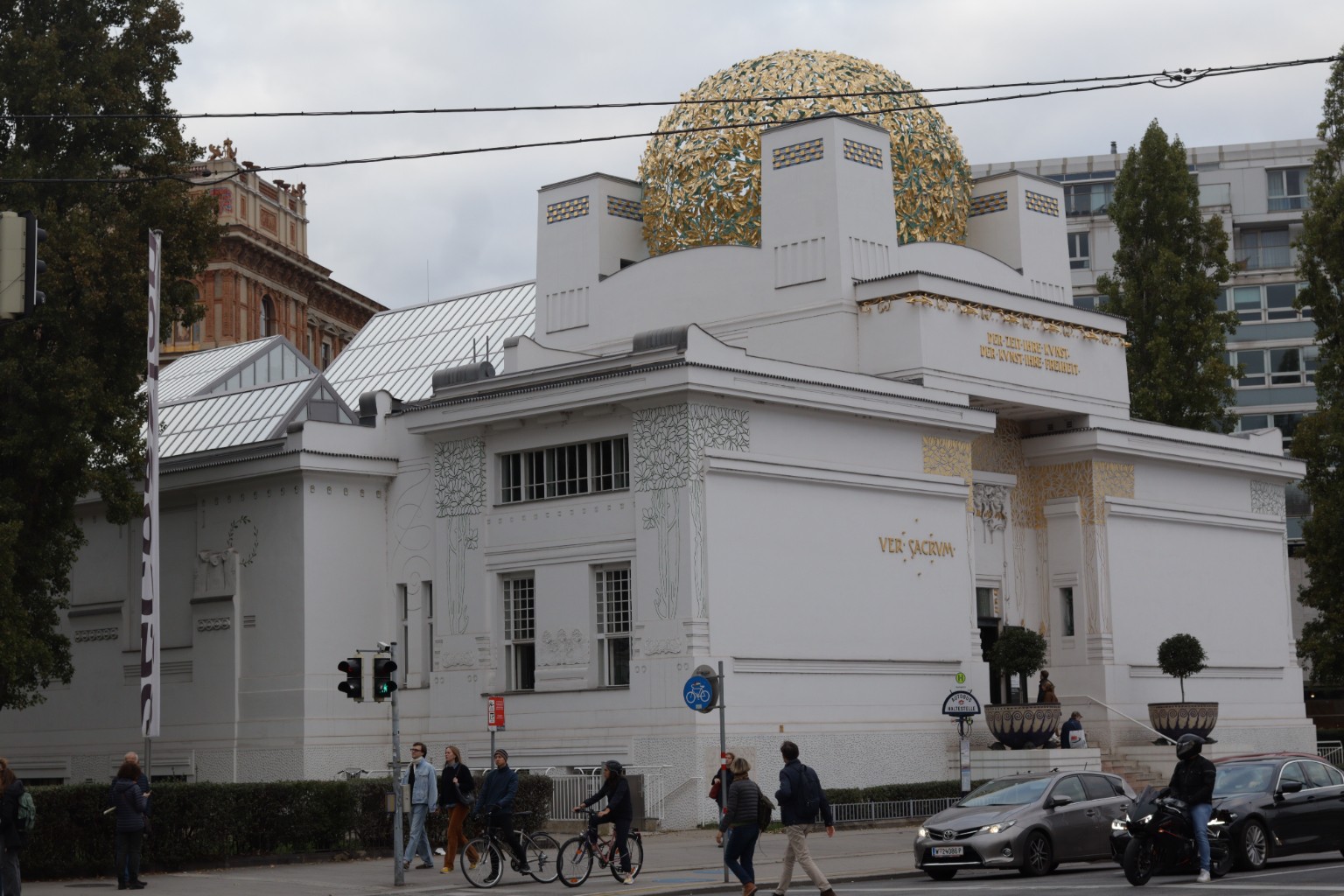
Photograph: VirtualTravelGuide.com.
The argument began a year before the building opened. In 1897, Gustav Klimt and other artists separated from the established Viennese artists’ association. They objected to the power of juries, the narrow tastes of official exhibitions and the idea that a respectable painting ought to resemble the paintings already hanging in respectable rooms. The new association called itself the Vienna Secession. It wanted the freedom to exhibit unfamiliar work and to invite artists from abroad.
Its exhibition building was designed by Joseph Maria Olbrich, a young architect associated with Otto Wagner’s circle. The site was near the Naschmarkt and Karlsplatz, close to the institutions of the imperial city but visually a long way from their historical ornament. Olbrich gave the artists a building whose surfaces could carry a few carefully chosen symbols without surrendering the clarity of its shape. The laurel crown became its unmistakable signature.
To Every Age Its Art
Above the entrance, the building announces its purpose in gold letters: “Der Zeit ihre Kunst. Der Kunst ihre Freiheit.” To every age its art. To art its freedom. The sentence still has force because it refuses the comfort of a permanent standard. What one generation calls beauty need not govern the next.
The inscription belongs to a Vienna that was changing quickly and uneasily. Around 1900 the Habsburg capital was home to new experiments in music, psychology, literature, painting and design. Klimt’s gilded figures, the work of architects such as Wagner and Hoffmann, and the unsettling ideas associated with Freud did not amount to one coordinated revolution. But they shared a willingness to examine conventions that had begun to feel exhausted.
The Secession artists also wanted to change the relationship between art and daily life. An exhibition could be shaped as a whole, with walls, lettering, objects and pictures considered together. Graphic design and decorative art deserved attention alongside painting. The magazine Ver Sacrum, whose Latin title means Sacred Spring, helped circulate their work and ideas. The words are visible on the side of the building in the photograph, a reminder that the movement had a publishing voice as well as an exhibition hall.
Beethoven Beneath the Dome
The building’s best-known work was made for a temporary exhibition. In 1902 the Secession staged an ambitious tribute to Ludwig van Beethoven. Klimt painted the Beethoven Frieze, a long, symbolic sequence inspired by interpretations of the Ninth Symphony. Figures representing human longing and suffering move toward a final embrace, while strange, threatening creatures interrupt their passage. It is beautiful in places and deliberately disturbing in others.
The frieze was never intended as a conventional permanent mural. It survived a complicated history of removal, ownership and conservation, and eventually returned to the Secession building, where visitors can see it today. Its survival gives the place a second life as a keeper of its own artistic past.
Klimt himself left the association in 1905 amid disagreements within the movement. That departure matters. The Secession’s founding ideal of freedom did not prevent disputes about what freedom meant, who controlled exhibitions or how art should meet the market. Artistic revolutions tend to produce their own institutions, and institutions soon have rules.
The Golden Cabbage Endures
Viennese critics nicknamed the dome the Golden Cabbage. The name has survived alongside the more reverent descriptions, and perhaps it should. The laurel leaves can look like a brilliant botanical tangle, especially under a grey sky. In this photograph their gold and blue-green shadows sit above a white building that seems almost stubbornly restrained.
The contrast is the point. Olbrich’s building belongs to the moment when European architecture began loosening its dependence on copied historical styles, yet it has no wish to erase ornament altogether. Its decorative language grows out of the geometry rather than covering it. Later modernists would go much further in stripping surfaces bare. The Secession stands at an earlier, more curious threshold.
The building has undergone restoration and change, and it continues to host contemporary exhibitions. That ongoing use is more faithful to the founding inscription than turning the hall into a sealed shrine to Klimt would have been. The artists who founded it asked for room to make the art of their own time. Their successors have to be allowed the same privilege.
Look once more at the photograph. The street is crowded with the ordinary machinery of a city: signals, cars, cables, a bus stop, cyclists waiting to cross. Behind them the white walls carry a sentence written more than a century ago. Vienna has changed around the building, and the building has become part of the heritage its founders challenged. The dome still catches the eye. The words underneath are the more difficult inheritance.