Lyon's Grand Hôtel-Dieu: Eight Centuries as a Hospital, Now a Hotel and Food Hall
The chapel front is the part most people photograph without knowing what they are looking at. It sits at a corner off Rue Bellecordière, wedged between café awnings and a modern glass shopfront, and the inscription cut into the stone above the door reads LE GRAND HOSTEL DIEV. Old spelling, U carved as V in the Roman manner. Above the door there is a Pietà in relief, which is the dedication itself: Notre-Dame de Pitié.
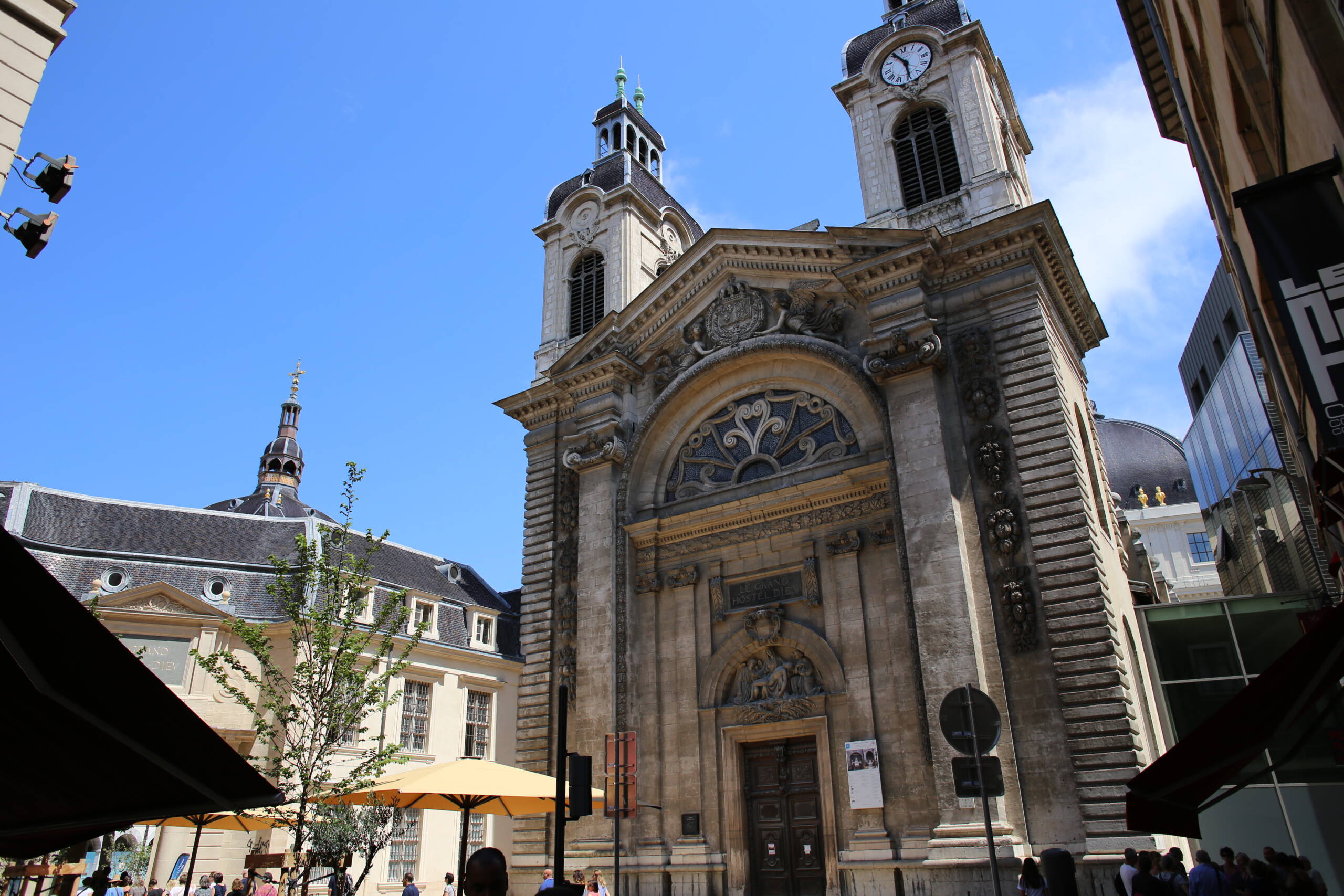
Look past the pediment and two towers appear at once. The near one carries the clock. The further one, softer and greener at the finials, belongs to the dome behind. That second one is the reason architectural historians come here at all.
A hospital that outlived most countries
The site has been in continuous use since the late twelfth century, when it opened as a hospice for travellers arriving at the Rhône bridge. It took in the poor, the sick, and anyone who had run out of road. It stayed in that business for roughly eight hundred years, which is a stretch of institutional survival almost nothing else in Europe can claim, and it did not stop taking patients until 2010.
François Rabelais worked here as a physician in the early 1530s, before the books, before the reputation. He was appointed at a salary that would embarrass a modern junior doctor and spent his hospital years dissecting cadavers and publishing medical texts. The building was already three and a half centuries old when he arrived.
That length of service explains why the complex reads as a collage rather than a single design. Each century added to it. The chapel facade is seventeenth-century. The courtyards behind are later. The scale kept ratcheting upward as Lyon grew rich on silk and then on chemicals and pharmaceuticals, and the hospital grew with it.
Soufflot’s dome, before the Panthéon
The dome you can see over the rooftops is the Grand Dôme, and it belongs to Jacques-Germain Soufflot, who took over the expansion in the 1740s. He was in his thirties, back from Rome, and Lyon gave him the commission that made his name.
The long river frontage is his: a classical facade running some 375 metres along the Rhône, symmetrical, restrained, absurdly confident for a building whose function was to house the destitute. It is the face of the Hôtel-Dieu that appears on postcards, and it was designed to be seen from the far bank and from the water.
Soufflot went on from Lyon to design Sainte-Geneviève in Paris, which the Revolution renamed the Panthéon. The dome logic he worked out here is visible there. Most visitors do the trip in the other direction, seeing the Panthéon first and then arriving in Lyon with a vague sense of having met the building before.
Closed in 2010, reopened in 2018
When the hospital services finally moved out to modern facilities, the city was left with 51,000 square metres of protected heritage and no use for it. The obvious outcomes were a slow decay behind hoardings or a gutting.
Neither happened. A long and expensive restoration reopened the site in 2018 as a mixed-use quarter: a luxury hotel in the historic wards, restaurants, shops, offices, and the city’s gastronomy centre. The courtyards, which had been closed to the public for eight centuries, were opened as passages. You can now walk through the middle of the complex without any reason to be there.
This is why the square in front of the chapel looks the way it does. Umbrellas, tables, a young tree, a steady drift of people cutting between the Presqu’île shopping streets and the river. The stone is the same stone. The traffic through it is entirely new.
Practical notes
The courtyards are free and open. The chapel is worth going inside for, and it is small enough that ten minutes covers it. The gastronomy centre charges admission and is aimed squarely at people who came to Lyon for the food, which is most of them.
Best light on the chapel facade is late morning through early afternoon, when the sun comes over the roofline and the rustication on the corner pilasters throws proper shadow. The Rhône frontage wants the opposite: late afternoon, from the Quai Victor Augagneur on the far bank, or from the Pont Wilson if you want the dome centred.
Go on a weekday if you can. On a Saturday the passage through the courtyards runs like a corridor at a train station.