The Padrão do Salado in Guimarães: Why Portugal's Birthplace Commemorates a Castilian Victory
Guimarães is where Portugal starts. Afonso Henriques was born here, fought the Battle of São Mamede here in 1128, and used the town as the base from which he detached the county of Portucale from León and made himself king. Every guidebook says so, usually with the words carved on a wall near the station: here Portugal was born. Which makes the shrine standing in the middle of the town’s oldest square slightly awkward, because it commemorates a battle Portugal fought on Castilian soil, in a Castilian dynastic cause, to defend a Castilian king.
The Square Came First
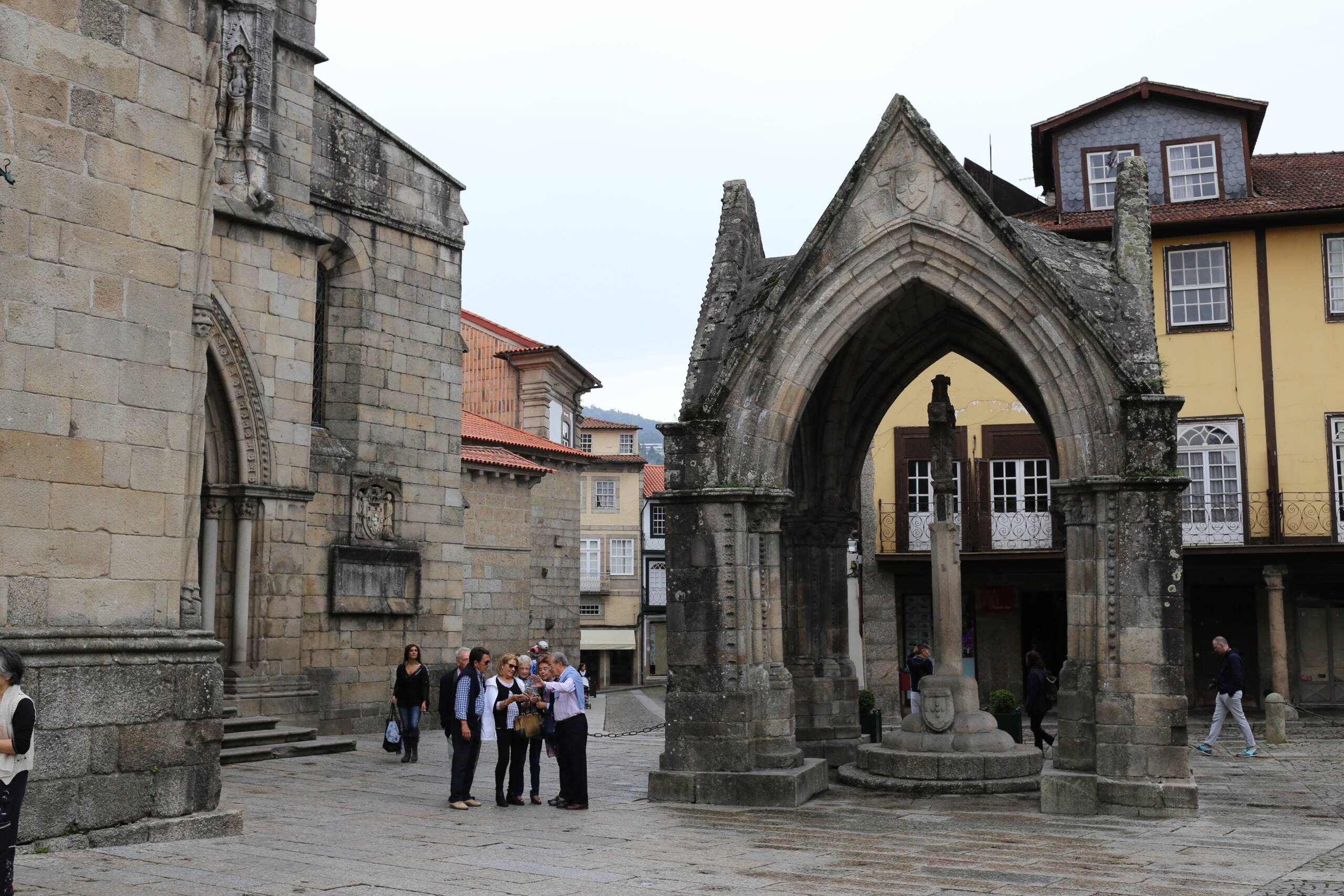
Largo da Oliveira was once simply Praça Maior, the main square, and the town grew outward from it. Its eastern side is closed by the Collegiate Church of Nossa Senhora da Oliveira, whose origins run back further than the kingdom does. In the first half of the tenth century, Countess Mumadona Dias founded a monastery on the site, a double house of monks and nuns, and retired to it at the end of her life. The castle up the hill was built to protect it from raiders coming up the rivers. Everything in Guimarães that later became national mythology started as a defensive arrangement around one aristocratic widow’s foundation.
The church you see now is the product of repeated rebuilding across six centuries. What survives from the medieval fabric is the granite: coursed ashlar, a pointed portal with heavy roll mouldings, a saint standing in a canopied niche high on the corner, a royal arms carved into the flank wall.
The Battle
On 30 October 1340, near the Río Salado outside Tarifa, a combined Portuguese and Castilian army met a Marinid force that had crossed from North Africa under Sultan Abu al-Hasan Ali, joined by Yusuf I of Granada. Afonso IV of Portugal was there in support of Alfonso XI of Castile, who happened to be his son-in-law and had, by most accounts, treated Afonso’s daughter badly enough to make the alliance a genuine act of statecraft rather than family feeling.
The Christian armies won. The significance was not local. Salado ended serious Maghrebi military intervention in Iberia. After it, no North African power crossed the strait in force again, and the reduction of Granada became a matter of Castilian timing rather than strategic contest. Afonso IV returned to Portugal with a share of the credit and ordered a monument.
The Shrine
The Padrão do Salado went up in 1340, granite and limestone, in the square outside the collegiate church. It is a small Gothic canopy, four piers carrying a steeply pointed arch with crocketing along the gable and a carved shield at the apex. Moss has taken the upper mouldings green. It reads as an extension of the church behind it, and it is not; it stands entirely on its own account.
Under the canopy is a stone cross, and the cross has a separate history from the shrine around it. It was given by Pero Esteves, a merchant, and made in Normandy. One face carries the Crucifixion, the other the Virgin. It was originally gilded and painted, which takes some imagination to reconstruct from the weathered grey object standing there now. The monument was classified as a national monument in 1910.
The Olive Tree
The square and the church are both named for an olive tree that no longer stands where it once did. The legend runs that a tree brought to the region withered and stopped bearing, and stayed dead until a cross was set beside it in 1342, at which point it greened again within three days. The miracle was credited to Our Lady of the Olive Tree, and the dedication stuck to the church, the square, and eventually the tourist map. The cross of the story is the one under the Padrão.
The chronology is worth noticing. The shrine is 1340, the miracle is 1342. A victory monument acquired a miracle two years after it was built, and the miracle then supplied the name for the entire square. Medieval commemoration worked by accretion. A thing gets erected for one reason and is subsequently explained by another, usually a better story.
The Awkward Part
Which returns to the tension. Portugal’s founding act was separation from León and Castile, and Guimarães is the stage set for that separation. Yet the town’s central square is dominated by a memorial to Portuguese and Castilian kings fighting on the same side, put up by a king whose main foreign policy problem was Castile.
It is not a contradiction so much as a corrective. The peninsular kingdoms spent the fourteenth century in a relationship that was neither alliance nor enmity but both, alternating by decade, tied together by marriages that produced as many wars as they prevented. Forty-five years after Salado, at Aljubarrota in 1385, Portugal fought Castile for its existence and won, and João I fulfilled a vow at this same church in 1387. Two monuments to two opposite outcomes, in one square, within a generation and a half of each other.
The version of history where Portugal simply faces down Castile is a later simplification. The square is more honest than the story told about it.