Vienna's Neuer Markt After the Garage: A Frame Down Plankengasse to the Donnerbrunnen
The camera is standing in shade, in a narrow lane in Vienna’s first district, looking east at a square full of flat grey daylight. Everything close to the lens is dark. Everything at the end of the lane is bright. That gap is the whole picture.
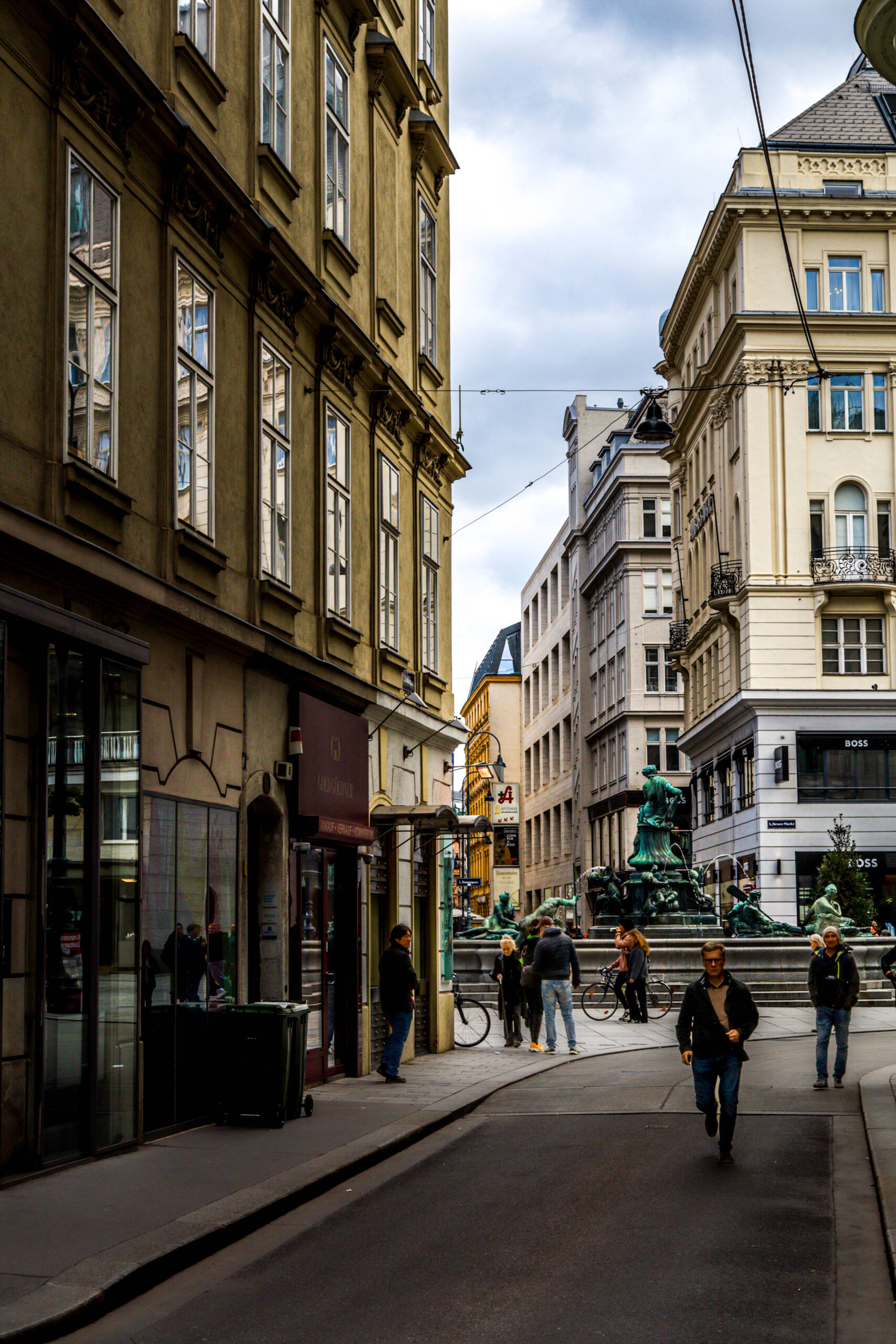
The left wall of the frame is a run of ochre plaster, five storeys of it, cut off by the top edge. The windows are tall and narrow with heavy sills and small carved brackets under them, and the glass on the upper floors is doing most of the work in that part of the picture: it is throwing back a mirrored, slightly warped copy of the building on the other side of the lane, so the left third of the image is a facade and a reflection of a facade at the same time. Lower down there is a dark shopfront in glass and thin black steel, then a burgundy awning with a small monogram and gold lettering that reads Gold Göldner, and under it the words for buying and selling. Two green wheelie bins have been rolled out onto the pavement below it. A man in a black jacket and jeans is standing in the shop doorway with his hands at his sides, doing nothing in particular. He is the only still figure on that side.
Past him the lane narrows further and the detail piles up. A wrought iron bracket carries a lantern out over the paving. A red pharmacy A hangs on a bracket further on, with Apotheke under it. There is a small yellow advertising panel, a shop sign in a script face, and a blue enamel street plate at head height, the standard Viennese kind with the district number in front of the name. Behind all of that, in the slot where the lane runs on, a yellow eighteenth century facade catches a little light and then the buildings stop.
Then the square opens. On the far side a modern block in pale limestone, flat and gridded, sits next to a heavy cream corner building with a mansard roof, iron balconies and a rounded oriel, and a BOSS sign over its ground floor. The blue plate on that corner says 1., Neuer Markt. Between the two, at the centre of the light, is the Donnerbrunnen: a granite basin on three steps, a baluster column rising from the middle of the water, a seated bronze figure on top with one arm raised, putti around the column base, and reclining bronze bodies along the rim with water running from the vessels they hold. Jets are up, so the picture was taken in the warm half of the year, whatever the coats suggest.
People are scattered around it in ones and twos. A woman in a red top with a bicycle, a couple of walkers with bags, someone in a dark parka standing right at the basin steps, a woman in white further back near the far corner. Two men are coming down the middle of the road toward the camera, one in glasses and a dark jacket over a tan sweater, close enough that his stride is sharp. The lane leaves the bottom right of the frame as dark asphalt with a granite kerb, and then the kerb stops. Where Plankengasse meets the square the ground turns pale and goes flat, wall to wall, with nothing raised on it and no car parked anywhere in the picture.
The fountain is a copy, and the square is gone
The lane is Plankengasse, which runs down from Dorotheergasse and meets Neuer Markt roughly level with the fountain. The gold dealer under the burgundy awning is at number 2, which is how the position can be fixed exactly.
The fountain has a formal name almost nobody uses. It is the Providentiabrunnen, built between 1737 and 1739 by Georg Raphael Donner on a commission from the city, and Viennese who had no use for the Latin named it after the sculptor instead. It was an unusual thing for its moment: a public monument in a Habsburg capital with no saints on it and no emperor, just Providence on her column and four allegorical bodies on the rim standing for tributaries of the Danube, the Traun, the Enns, the Ybbs and the March.
The nudity got them into trouble. In 1770 Maria Theresa had the figures taken off and sent to a depot to be melted down. The sculptor given that job, Johann Martin Fischer, decided they were too good to destroy, restored them quietly, and got them put back on the square in 1801. Weather did what the empress could not, and in 1873 the lead figures were replaced with bronze casts. The originals went into storage, then to the Lower Belvedere in 1921 as a long loan, and they are in the Wien Museum now. The bronzes came off again during the war and went back up in 1947. So the thing standing in this photograph is a cast of a set of statues that has been removed from the square three separate times, and the tourists touching the polished spots are touching 1873.
They came off a fourth time in October 2018, and that removal is why the square looks the way it does here. Neuer Markt was closed in January 2019 and dug out to four basement levels for a car park of just over four hundred spaces. Until then the surface had been a parking lot for about fifty cars with the fountain sitting in the middle of them. The rebuild gave it a pale granite floor laid level from building line to building line, with seating and mist nozzles and no kerbs, and the bronzes came back from a restorer in Burgenland in August 2022.
So the ground in this photograph is three years old and the buildings around it are three centuries old, and the seam between the two runs right across the frame where the black asphalt of the lane stops. The picture was taken in October 2025. It shows the finished version of an argument the district ran for the better part of two decades, and the thing that settles it visually is not the granite. It is that nothing is parked on it.
Why the lane does the work
Shooting from inside a dark street into a bright open space is a gift and a trap. The gift is the frame: two black walls that force the eye down the middle and hand you a lit subject at the end of the tunnel with no effort at all. The trap is exposure. Meter for the shaded facades and the square blows out and the fountain disappears into white.
Here the exposure is held for the square, which is the right call. The shadowed left wall goes heavy and the window reflections survive as the only bright thing on that side. The overcast sky is thin and empty, so the sensible move would be to crop most of it out, and the vertical frame keeps more of it than it needs.
The lane has been pointing at that fountain since Donner was alive. It only recently stopped pointing at a car park.